










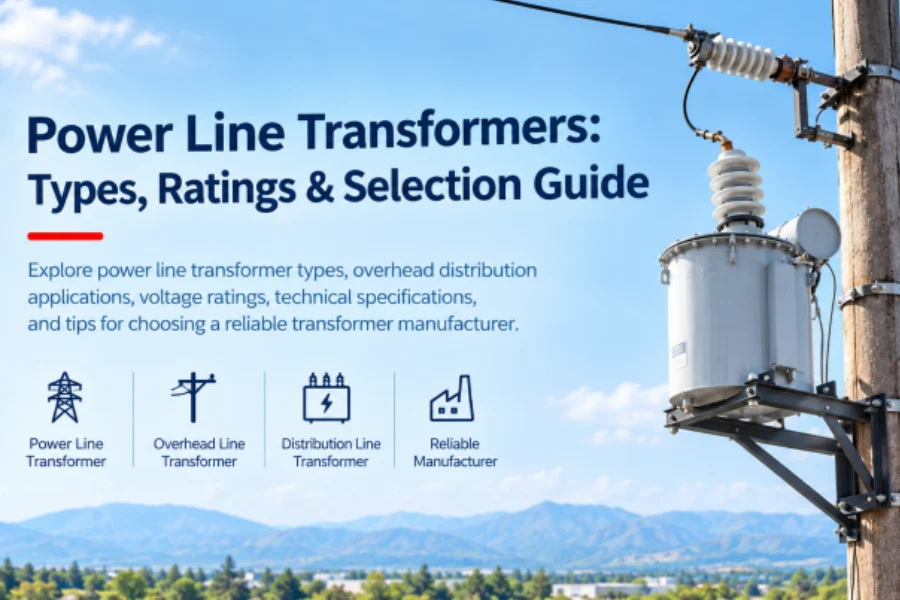
Power line transformers play an essential role in electrical distribution networks by converting voltage levels to meet the requirements of utilities, commercial facilities, industrial plants, and residential customers. Selecting the right transformer requires more than matching rated capacity. Buyers must also consider system voltage, phase configuration, insulation level, energy losses, installation conditions, and applicable electrical standards.
For utilities, EPC contractors, electrical equipment distributors, and industrial project developers, working with an experienced transformer manufacturer helps ensure that the equipment meets project specifications and provides reliable long-term performance.
Sichuan Yawei Transformer supplies distribution transformer solutions for different power distribution applications. This guide explains the main types of power line transformers, common voltage ratings, practical selection criteria, and what to evaluate when choosing a transformer manufacturer.
1. What Is a Power Line Transformer?
A power line transformer is a transformer used within an electrical power network to transfer energy between circuits at different voltage levels through electromagnetic induction. In distribution systems, transformers typically reduce medium voltage to a lower voltage suitable for end users.
The term power line transformer can describe different transformer applications rather than one specific product design. An overhead line transformer is associated with overhead electrical distribution networks, while a distribution line transformer generally serves the distribution stage between the utility network and the final electrical loads.
Pole-mounted transformers are one of the most common solutions for overhead distribution systems. They are installed on utility poles and are widely used in residential communities, rural electrification projects, agricultural facilities, and other applications where overhead lines are practical.
When requesting a quotation, buyers should specify the installation type, voltage ratio, rated capacity, phase configuration, and applicable utility requirements rather than relying on the product name alone.
2. Main Types of Power Line Transformers
Pole-Mounted Distribution Transformers
Pole-mounted transformers are designed for installation on utility poles as part of overhead distribution networks. They are available in single-phase and three-phase configurations, depending on the local network and load requirements.
Single-phase pole-mounted transformers are commonly used for residential loads and smaller distribution applications. Three-phase units can serve commercial buildings, agricultural facilities, and other customers requiring three-phase power.
Depending on the utility specification, designs may include conventional or Completely Self-Protected (CSP) configurations. Required protective devices and accessories should be confirmed against the purchaser’s technical specification.
Oil-Immersed Distribution Transformers
Oil-immersed transformers use insulating liquid for electrical insulation and heat dissipation. They are widely used in outdoor distribution systems because of their established design, practical maintenance requirements, and suitability for a broad range of capacities and voltage ratings.
Design options can include different winding materials, cooling arrangements, tap settings, insulation levels, and tank configurations. The final design should be selected according to electrical requirements, operating conditions, and applicable standards.
Dry-Type Transformers
Dry-type transformers use solid insulation rather than insulating liquid. They are commonly selected for indoor installations, commercial buildings, industrial facilities, and locations where fire safety or environmental considerations influence equipment selection.
Dry-type transformers are not automatically interchangeable with outdoor pole-mounted oil-immersed units. The appropriate solution depends on the installation environment, network configuration, and project specifications.
3. Voltage Ratings, Capacity, and Phase Configuration
The primary voltage of a power line transformer must match the distribution network, while the secondary voltage must meet the requirements of the connected loads.
Common medium-voltage distribution levels include 11 kV, 13.2 kV, 13.8 kV, 20 kV, and 33 kV. Actual voltage levels vary by country, utility, and network design.
Common low-voltage systems include 400/230 V, 415/240 V, and 480/277 V three-phase configurations. North American residential distribution may also use 120/240 V single-phase systems. These examples are not interchangeable; the required connection and nominal voltage must be confirmed for each project.
Transformer capacity is normally expressed in kilovolt-amperes (kVA) or megavolt-amperes (MVA). The required rating depends on the expected load, power factor, operating profile, starting currents, and anticipated future demand.
For example, a project using a 13.8 kV three-phase distribution network to supply 480 V equipment may require a three-phase transformer designed for the specified primary and secondary voltages. A residential overhead network using a 19.92 kV primary and 120/240 V single-phase secondary may require a different transformer configuration, depending on the utility’s grounding and distribution arrangement.
These examples illustrate why voltage ratio, phase configuration, and connection requirements should be confirmed before a manufacturer prepares a quotation.
4. Key Technical Parameters to Confirm Before Ordering
A complete transformer specification helps manufacturers provide accurate quotations and reduces the risk of technical misunderstandings.
Buyers should confirm the following parameters:
Rated capacity: The required kVA or MVA rating based on the calculated load and expected operating conditions.
Primary and secondary voltage: The nominal voltage of the supply network and the required output voltage.
Phase and frequency: Single-phase or three-phase operation, at 50 Hz or 60 Hz as applicable.
Connection and vector group: Required winding connections, neutral arrangement, and phase displacement where applicable.
Impedance and short-circuit requirements: Values must be coordinated with the network design and relevant utility specifications.
Insulation level and BIL: The required insulation withstand capability, including lightning impulse withstand where specified.
Tap changer: The required tap range, step size, and whether off-circuit or on-load adjustment is necessary.
Loss requirements: Guaranteed no-load and load losses, according to the applicable test and evaluation requirements.
Installation and environmental conditions: Outdoor or indoor installation, ambient temperature, altitude, humidity, and other relevant site conditions.
Applicable standards: For example, IEC 60076 or the relevant IEEE C57 series standards, together with any national or utility-specific requirements.
The required accessories, protection devices, bushings, terminals, enclosure details, and inspection documentation should also be listed in the technical specification.
5. How to Choose a Reliable Power Line Transformer Manufacturer
Price is important, but the lowest initial quotation does not necessarily provide the best long-term value. Buyers should compare manufacturers using consistent technical and commercial criteria.
Technical capability: Confirm that the manufacturer can meet the required voltage ratio, rated capacity, phase configuration, insulation level, and other project-specific parameters.
Quality assurance and testing: Ask about applicable routine tests, inspection procedures, test reports, and the documentation supplied with each transformer. Type or special tests should be confirmed according to the purchase specification.
Energy efficiency: Compare guaranteed no-load and load losses using the same evaluation conditions. Lower losses can reduce lifetime energy consumption, particularly for continuously energized distribution transformers.
Customization and compliance: Verify the manufacturer’s ability to follow the applicable IEC, IEEE, national, or utility requirements. Any requested certification should be checked against the specific product and its intended market.
Delivery and after-sales support: Confirm production lead time, export packaging, shipping arrangements, warranty conditions, and the availability of technical support.
A clear technical review before production helps align the final equipment with the purchaser’s requirements and reduces the likelihood of costly changes later.
6. Power Line Transformer Solutions from Yawei Transformer
Sichuan Yawei Transformer focuses on distribution transformer products, including oil-immersed transformers, dry-type transformers, and related power distribution equipment. Customized solutions can be evaluated according to the required capacity, voltage level, configuration, installation conditions, and applicable technical standards.
For international utility projects, distributors, and electrical contractors, the selection process begins with a clear understanding of the network and the intended application. Providing complete technical information enables the manufacturer to assess the required design and prepare a more accurate quotation.
Buyers should review the proposed technical specifications, guaranteed losses, testing requirements, delivery schedule, and commercial terms before confirming an order.
7. Request a Power Line Transformer Quotation
Are you sourcing a power line transformer, overhead line transformer, or distribution transformer for a utility network, commercial development, industrial facility, or rural electrification project?
To help us evaluate your requirements, please provide:
Rated capacity and required quantity
Primary and secondary voltages
Single-phase or three-phase configuration
Frequency and connection requirements
Applicable IEC, IEEE, or local utility standards
Installation environment and destination country
Required loss levels, accessories, and delivery schedule
Contact Sichuan Yawei Transformer to discuss your power distribution requirements and request a customized transformer quotation.
Website: https://yawei-powertransformer.com/
Email: info@yawei-powertransformer.com