










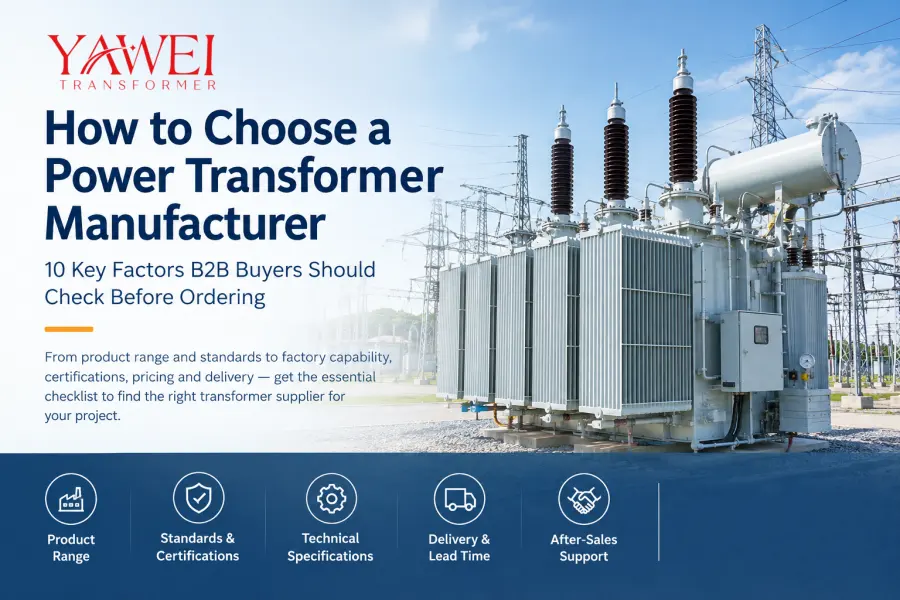
Choosing the right power transformer manufacturer is an important decision for utilities, EPC contractors, industrial companies, renewable energy developers, electrical distributors, and other professional buyers. A transformer is not simply a standard electrical product that can be selected by comparing unit prices. Voltage requirements, capacity, applicable standards, efficiency, installation conditions, delivery schedules, testing, and after-sales support can all affect the success of a power project.
For buyers preparing a transformer purchase, one of the first questions is often: How can I determine whether a transformer manufacturer is suitable for my project?
The answer depends on more than the manufacturer’s quotation. A reliable evaluation should consider the manufacturer’s production capabilities, technical experience, product range, standards and certifications, customization capabilities, quality control, delivery capacity, and ability to provide technical support throughout the project.
This guide explains the key factors B2B buyers should consider before selecting a power transformer manufacturer or sending a transformer RFQ.
1. Check the Manufacturer’s Product Range
The first step is to determine whether the manufacturer actually produces the type of transformer required for your project. Different applications can require very different transformer configurations, even when they have similar rated capacities.
A transformer manufacturer may specialize in distribution transformers, محولات من النوع الجاف, oil-immersed transformers, محولات مثبتة على وسادة, المحولات المثبتة على أعمدة, محولات الطاقة, renewable energy transformers, or substation equipment. For larger projects, buyers may also require several transformer types from the same supplier.
A manufacturer with a broad product range can be useful when an EPC contractor or project owner needs different transformer configurations for one project or multiple projects. Before requesting a quotation, check the manufacturer’s voltage and capacity range as well as the applications it serves.
Yawei Transformer provides transformer solutions covering distribution and power applications, with products designed for utility, industrial, renewable energy, infrastructure, and other power systems.
2. Verify That the Supplier Has Real Manufacturing Capability
For a B2B transformer purchase, it is important to understand whether you are dealing directly with a manufacturer or primarily with a trading company.
A genuine transformer factory should be able to provide information about its production facilities, manufacturing processes, testing equipment, quality control procedures, and production capacity. Depending on the size and importance of the project, buyers may also request factory photographs, production videos, technical drawings, sample test reports, or arrange a factory inspection.
Manufacturing capability becomes particularly important for projects involving multiple transformers or customized designs. The supplier should be able to maintain consistent technical specifications and quality across the complete production batch.
For large projects, buyers can also consider factory acceptance testing, third-party inspection, or other quality verification procedures before shipment.
3. Confirm the Applicable Transformer Standards
The required transformer standard depends on the project country, utility requirements, application, and purchaser’s technical specification.
For projects in North America, buyers may encounter ANSI, IEEE, UL, and CSA requirements. For many international and European projects, IEC standards are commonly specified. Other markets may have additional national or utility-specific requirements.
The important point is that buyers should confirm the applicable standard before placing an order rather than assuming that one international standard will automatically satisfy every project.
The transformer quotation should clearly state the applicable standards and the relevant testing requirements. If a project requires specific certification or documentation, these requirements should be confirmed with the manufacturer before production begins.
4. Confirm the Transformer’s Main Technical Specifications
A transformer quotation can only be compared accurately when the main technical parameters are clearly defined.
Important information normally includes rated capacity, primary voltage, secondary voltage, frequency, phase, vector group, impedance, tap range, cooling method, insulation level, winding material, installation conditions, and applicable standard.
For example, a requirement might be:
1000 kVA, 13.8 kV / 480Y/277 V, 60 Hz, three-phase, Dyn1, ONAN, ANSI/IEEE.
This specification is much more useful for a manufacturer than simply asking for a “1000 kVA transformer.”
Buyers should also pay attention to environmental conditions. High-altitude installations, high ambient temperatures, coastal environments, dusty locations, outdoor installations, and renewable energy applications may require additional design considerations.
If the project specification is available, it is usually better to send the complete technical specification to the manufacturer rather than manually removing information that may appear unnecessary. The engineering team can then review the requirements and identify any technical points that need clarification.
5. Ask Whether Customized Transformer Designs Are Available
Many industrial and infrastructure projects cannot use a completely standard transformer configuration.
Depending on the application, buyers may require customized voltage ratios, impedance, tap ranges, insulation levels, winding materials, enclosure configurations, cooling systems, or mechanical dimensions.
Special environmental conditions can also influence the design. Transformers for high-altitude locations, solar farms, battery energy storage systems, data centers, industrial facilities, and utility substations may have different requirements from conventional distribution transformers.
A capable manufacturer should therefore be able to review project-specific requirements and provide an appropriate design rather than simply offering the closest standard model.
For EPC contractors and engineering companies, this capability can be especially important because transformer specifications may need to match the overall electrical system, switchgear, cables, protection system, and site conditions.
6. Check Certifications, Testing, and Technical Documentation
Before purchasing a transformer, buyers should understand what documentation will be supplied with the equipment.
Depending on the project, this may include factory routine test reports, type test reports, product drawings, nameplate information, material documentation, inspection records, certificates, and other quality documents.
Testing is an important part of transformer manufacturing because it verifies whether the finished product meets the required technical specifications.
For international projects, buyers should also confirm certification requirements at the quotation stage. For example, a project in North America may have different certification and documentation requirements from a project based on IEC standards.
Do not simply ask whether a transformer is “certified.” Instead, specify which certification, standard, test, or project requirement applies to your application.
7. Compare Total Project Cost Instead of Only the Transformer Price
Price is naturally an important factor in transformer procurement, but comparing only the initial purchase price can make it difficult to understand the actual project cost.
Buyers should also consider transformer efficiency, no-load losses, load losses, transportation, testing, certification, installation requirements, maintenance, warranty, spare parts, and technical support.
For a transformer expected to operate continuously for many years, electrical losses can become an important part of its overall operating cost. Therefore, a meaningful comparison should consider both the initial purchase price and the expected operating requirements.
When comparing quotations from different manufacturers, make sure that the technical specifications are equivalent. A lower quotation may not represent the same product if the capacity, losses, materials, insulation level, accessories, testing, or documentation are different.
8. Evaluate Production Capacity and Delivery Time
Transformer procurement can directly affect an EPC or construction schedule. A technically suitable transformer that cannot be delivered on time may create additional costs and project delays.
Before placing an order, buyers should ask about production lead time, testing time, shipping preparation, and the manufacturer’s current production schedule.
For projects requiring several transformers, it is also useful to confirm whether the manufacturer can produce the complete quantity within the required schedule while maintaining consistent specifications.
The delivery schedule should ideally be confirmed in writing as part of the commercial and technical agreement. Buyers should also clarify when the lead time begins, such as after receipt of the advance payment, approval of drawings, or final technical confirmation.
9. Consider Technical Support and After-Sales Service
Transformer supply does not necessarily end when the equipment leaves the factory.
Depending on the project, buyers may require support with drawing confirmation, installation, commissioning, oil treatment, troubleshooting, spare parts, warranty issues, or other technical questions.
For large power transformers and customized equipment, communication between the manufacturer, EPC contractor, electrical engineer, and installation team can be particularly important.
When evaluating a supplier, buyers should therefore consider not only the product itself but also how the manufacturer communicates during technical clarification, production, inspection, shipment, installation, and after-sales service.
A clear communication process can reduce misunderstandings and help prevent avoidable problems during the project.
10. Send a Complete Transformer RFQ
Once you have identified a potential manufacturer, the most effective way to obtain an accurate quotation is to provide as much relevant project information as possible.
A typical transformer RFQ should include the transformer type, rated capacity, primary and secondary voltage, frequency, phase, vector group, impedance, tap range, cooling method, applicable standard, quantity, installation location, destination country, and required delivery date.
على سبيل المثال:
نوع المحول: Oil-Immersed Distribution Transformer
السعة المقدرة: 1000 كيلو فولت أمبير
الجهد الأساسي: 13.8 كيلو فولت
الجهد الثانوي: 480 ص / 277 فولت
التردد: 60 هرتز
Phase: ثلاث مراحل
Vector Group: Dyn1
التبريد: مكتب الأمم المتحدة لتنسيق الشؤون الإنسانية
Standard: ANSI/IEEE
Quantity: 10 units
Destination: الولايات المتحدة الأمريكية
Required Delivery: December 2026
If you do not have all of the technical information available, you can still contact a transformer manufacturer. An existing transformer nameplate, technical specification, project drawing, single-line diagram, or photograph of the existing equipment can provide useful information for the manufacturer to review.
The more complete the RFQ is, the easier it is for the manufacturer to prepare a technically accurate quotation and identify any requirements that need clarification.
What Should You Ask a Transformer Manufacturer Before Ordering?
Before placing an order, B2B buyers should have clear answers to several basic questions:
Does the manufacturer produce the required transformer type and capacity? Can the transformer be designed according to the project’s voltage, frequency, standards, and environmental conditions? Which tests and certifications are available? What documents will be provided? What is the production lead time? How will the transformer be inspected before shipment? What warranty and technical support are included?
These questions can help buyers compare suppliers on a consistent basis instead of comparing price alone.
For EPC contractors, distributors, utilities, industrial companies, and renewable energy developers, establishing these requirements at the beginning of the procurement process can also make communication with the transformer manufacturer more efficient.
Request a Transformer Quotation from Yawei Transformer
Yawei Transformer provides customized transformer solutions for utility, industrial, renewable energy, infrastructure, and other power applications. Our product range includes oil-immersed transformers, dry-type transformers, distribution transformers, pad-mounted transformers, pole-mounted transformers, and other transformer solutions.
If you are preparing a transformer procurement project, you can send us your technical specification, project drawing, existing transformer nameplate, or basic requirements for review.
For a faster quotation, please provide the rated capacity, primary voltage, secondary voltage, frequency, quantity, applicable standard, destination, and required delivery date whenever possible.
Our team can review your requirements and confirm the suitable transformer configuration, technical specifications, and commercial quotation.
Contact Yawei Transformer for your transformer project:
البريد الإلكتروني: info@yawei-powertransformer.com
Website: https://yawei-powertransformer.com/
WhatsApp: +86 158 2828 4573
Whether you are purchasing a single transformer or sourcing equipment for a larger EPC, utility, industrial, solar, BESS, or infrastructure project, providing amailto:info@yawei-powertransformer.com clear RFQ is the first step toward obtaining an accurate transformer solution.