

Yawei Transformer Glossary A–Z
This glossary page provides a comprehensive A–Z index of over 100 transformer-related terms, including specialized vocabulary for UHV transformers, 500kV systems, 1200MVA units, and global power transmission contexts. Each entry includes detailed explanations for SEO-rich content, technical clarity, and industry relevance.
A
Ambient Temperature: The surrounding temperature where the transformer operates. Critical for calculating transformer ratings, thermal performance, and insulation life, especially in UHV 500kV and 1200MVA units.
Air Insulated Switchgear (AIS): Switchgear using air as the primary insulation medium. Often paired with high-voltage transformers for utility substations.
Auto-transformer: A transformer with a single winding that acts as both primary and secondary. Used for voltage regulation in high-capacity systems.
Ampere (A): Unit of electric current. Essential for calculating transformer load, thermal limits, and current carrying capacity.
Active Power (P): The real power delivered by a transformer, measured in watts or megawatts. Determines transformer sizing in large-scale UHV projects.
B
BIL (Basic Insulation Level): A standard defining transformer insulation capability against voltage surges. Key in 500kV and UHV transformer designs.
Breakdown Voltage: The voltage at which transformer insulation fails. Critical for safety, reliability, and long-term operation.
Busbar: Conductors used to connect transformers to distribution or transmission networks, enabling multiple circuits.
Bushings: Insulated devices allowing conductors to pass through transformer tanks safely. High-voltage bushings are critical for 500kV and UHV systems.
Bypass Switch: A switch used to divert current around a transformer for maintenance or operational flexibility.
C
Cooling Oil: Mineral or synthetic oil used in oil-immersed transformers for heat dissipation. Important in UHV 500kV transformers for maintaining safe temperature rise.
Core: The magnetic core of a transformer that guides flux and reduces losses. Constructed from high-grade silicon steel.
Current Transformer (CT): Device that scales down high currents for measurement and protection systems.
Conservator Tank: Oil expansion tank for transformers allowing volume changes due to thermal expansion.
Capacitive Voltage Transformer (CVT): Measures high voltage for metering and protection in transmission networks.
D
Delta Connection (Δ): Transformer winding configuration forming a closed loop. Common in three-phase systems.
Dielectric Strength: Measure of insulation’s ability to withstand voltage stress. Vital for UHV transformers.
Distribution Transformer: Transforms medium voltage to low voltage for final delivery to consumers.
Damping: Methods to reduce oscillations or mechanical vibrations in transformer windings.
Direct Current (DC): Flow of electric charge in one direction. Special transformers convert AC to DC for industrial applications.
E
Eddy Currents: Circulating currents in transformer cores causing energy loss. Minimized with laminated cores.
Energy Efficiency: Measurement of input power versus output power. High-efficiency designs reduce losses in 1200MVA transformers.
Excitation Current: Current required to magnetize the transformer core, influencing no-load losses.
Electrical Insulation: Material preventing current flow between conductive parts. Essential in all transformer classes.
Earth Fault: Short circuit between phase and ground. Protection devices rely on CTs and relays to detect and isolate faults.
F
Feeder: Conductor delivering power from the transformer to distribution circuits.
Frequency (Hz): Alternating current cycles per second. Transformers designed for standard frequencies (50Hz or 60Hz).
Furnace Transformer: Special-purpose transformer for electric furnaces, designed for high short-circuit currents.
Fluid-Immersed Transformer: Transformer immersed in dielectric fluid, usually mineral oil, for cooling and insulation.
Fault Current: High current during short circuits; transformer and switchgear ratings must consider this for safety.
G
Generator Step-Up Transformer (GSU): Connects power generators to the high-voltage transmission network, stepping up voltage to 500kV or higher.
Grounding Transformer: Provides neutral grounding in ungrounded systems to stabilize voltage and limit fault currents.
Grid Stability: Ability of the power system to maintain consistent voltage and frequency under varying loads and faults.
Gas-Insulated Transformer (GIT): Transformers using SF6 or other insulating gases, often in compact urban substations.
Gap Cooling: Method to improve heat dissipation in transformers by designing airflow or fluid gaps.
H
Harmonics: Voltage or current deviations from pure sine waves, impacting transformer heating and lifetime.
HV (High Voltage): Generally 66kV–220kV; UHV refers to voltages like 500kV.
Hot-Spot Temperature: Maximum temperature within transformer windings, used to determine aging and insulation life.
Hybrid Transformer: Transformer combining multiple core or winding technologies to optimize efficiency.
Hydraulic Control: Systems regulating tap changers and cooling oil circulation in large transformers.
I
Impedance (Z): Opposition to AC current flow, determining short-circuit currents and voltage drop.
Insulating Oil: Fluid providing dielectric strength and cooling. Key for 500kV oil-immersed units.
Insulation Class: Rating of temperature tolerance of transformer insulation.
Isolation Transformer: Provides galvanic separation between circuits for safety or voltage matching.
Intelligent Monitoring: Digital sensors for real-time transformer diagnostics and predictive maintenance.
J
Joule Losses: Heat losses due to resistance in windings, calculated for efficiency improvement.
Jacket Cooling: Cooling method where oil circulates in an external jacket around transformer windings.
Jumpers: Short conductors used to connect transformer terminals to busbars or circuits.
Jointing: Proper connection of windings, leads, and terminals to reduce resistance and heating.
Junction Box: Protective enclosure for transformer connections and control devices.
K
KVA Rating: Transformer apparent power capacity, critical for sizing in 500kV, 1200MVA installations.
K-factor: Transformer rating for handling non-linear loads, protecting against harmonic heating.
Kilovolts (kV): Voltage unit. 500kV and above is considered UHV.
Keyed Tap Changer: Mechanically selected tap changer for voltage regulation.
Kelvin Measurement: Temperature measurement at specific points, often for winding hot spots.
L
Load Tap Changer (LTC): Adjusts transformer output voltage under load conditions, essential in large grids.
Leakage Reactance: Reactance due to flux leakage; affects voltage regulation.
Liquid-Filled Transformer: Transformer immersed in dielectric oil for insulation and cooling.
Line Drop Compensation: LTC control to maintain voltage at distribution endpoints.
Lightning Impulse Test: Tests transformer insulation against transient voltage surges.
M
Magnetic Core: Core guiding flux; reduces hysteresis and eddy current losses.
Magnetizing Current: Current required to establish flux in transformer core.
Medium Voltage (MV): 1kV–35kV range for distribution transformers.
Moisture Content: Water in insulation or oil reduces dielectric strength; critical for UHV transformer reliability.
Maintenance Schedule: Planned inspection, testing, and servicing to extend transformer life.
N
Neutral Point: Connection point of three-phase transformer windings; grounding affects fault protection.
No-Load Losses: Losses when transformer operates without load; minimized in high-efficiency designs.
Noise Level: Audible transformer noise; compliance needed for urban installations.
NEMA Standards: North American regulatory standards for electrical equipment.
Nominal Voltage: Standard voltage rating for system compatibility.
O
Oil Preservation System: Maintains oil volume and prevents moisture ingress.
Open Delta (V-Connection): Two-transformer configuration to supply three-phase power when one unit is unavailable.
Overload Capacity: Transformer ability to handle temporary excess load.
Overvoltage Protection: Devices or design features preventing insulation failure.
Outdoor Transformer: Designed for open-air installations with weatherproof enclosures.
P
Partial Discharge (PD): Localized insulation breakdown; early indicator of potential transformer failure.
Power Factor: Ratio of active to apparent power; impacts transformer efficiency.
Protective Relay: Device triggering circuit breakers under fault conditions.
Phase Shift: Voltage angle difference between primary and secondary; important for load sharing.
Pulley Cooling: Mechanical system driving fans for forced cooling.
Q
Quality Assurance (QA): Systematic process ensuring transformers meet specifications.
Quick Tap Change: Fast adjustment of voltage using on-load tap changer.
Quenching: Cooling process to prevent overheating in special-purpose transformers.
Quantity of Oil: Correct volume ensures optimal cooling in large-capacity transformers.
Quarter-Wave Resonance: Electrical resonance issue considered in HV design.
R
Rated Capacity: Maximum designed load a transformer can carry.
Rated Voltage: Nominal voltage at which transformer operates efficiently.
Reactive Power (Q): Non-working power influencing voltage regulation.
Rectifier Transformer: Converts AC to DC for industrial and traction applications.
Regulation: Voltage change under load; critical for system stability.
S
Short-Circuit Impedance: Determines fault current and voltage drop.
Substation Transformer: Transformers installed in substations for voltage step-up/down.
Saturated Core: Core operating beyond linear flux; increases losses and heating.
SF6 Insulated Transformer: Uses sulfur hexafluoride gas for insulation, common in compact urban installations.
Step-Up Transformer: Increases voltage from generator output to transmission levels, e.g., 500kV.
T
Tap Changer: Adjusts voltage by changing winding connections.
Thermal Rating: Maximum temperature transformer can withstand safely.
Three-Phase Transformer: Common in transmission and distribution networks.
Transformer Oil Testing: Ensures dielectric strength and contamination levels are acceptable.
Tripping Mechanism: Activates breaker during fault conditions.
U
UHV (Ultra-High Voltage): Voltage levels above 800kV AC; specialized design required.
Unbalanced Load: Unequal phase loading; affects transformer losses and efficiency.
Upstream Network: Portion of the grid supplying transformer primary side.
Under-Load Tap Changer (ULTC): Adjusts voltage while transformer is operating.
Utility-Grade Transformer: Designed for high reliability and long life in power grids.
V
Vector Group: Defines winding connection type and phase displacement.
Voltage Regulation: Control of output voltage under varying loads.
Vacuum Circuit Breaker (VCB): Switchgear for high-voltage protection.
Ventilation: Forced or natural air movement for cooling dry-type transformers.
Voltage Class: Standardized rating for transformer insulation.
W
Winding Resistance: Electrical resistance of transformer windings.
Watt Loss: Power loss due to resistance and core losses.
Water-Cooled Transformer: Cooling using water for large capacity or specialized installations.
Waveform Distortion: Non-sinusoidal waveform affecting transformer operation.
Wind Farm Transformer: Custom transformer for renewable energy integration.
X
X/R Ratio: Ratio of reactance to resistance; affects short-circuit calculations.
X-mer Transformer: Special designation for experimental or prototype transformers.
XHV (Extra-High Voltage): Voltages from 345kV to 800kV; above HV and MV.
X-Phase Shift: Phase angle modification for power flow optimization.
X-Connected Windings: Custom winding connection to manage harmonics and load sharing.
Y
Y-Delta Connection: Winding configuration combining star and delta for phase balancing.
Yyn0 Transformer: Common distribution transformer vector group.
Yield Strength: Mechanical property of transformer tank material.
Yearly Maintenance: Routine checks for reliability and extended transformer life.
Yellow Oil Indicator: Visual sign for oil quality and contamination.
Z
Zinc-Coated Tank: Corrosion-resistant transformer enclosure.
Zero Sequence Current: Ground fault current measurement.
Zone Protection: Protective relay arrangement isolating faulted section.
Zig-Zag Transformer: Used for grounding and phase-shifting.
Z-Phase Monitoring: Measurement for advanced diagnostics and fault detection.
Latest News
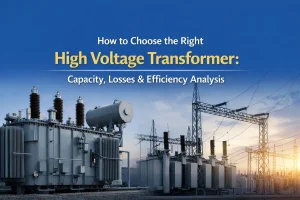
How to Choose the Right High Voltage Transformer: Capacity, Losses & Efficiency Analysis
A Complete Engineering Guide for Utilities, EPC Contractors & Industrial Buyers Selecting the correct high [...]
Feb
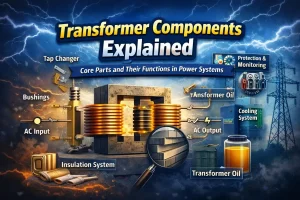
Transformer Components Explained: Core Parts and Their Functions in Power Systems
Introduction Understanding transformer components is essential for engineers, power utilities, and industrial buyers. While many [...]
Feb
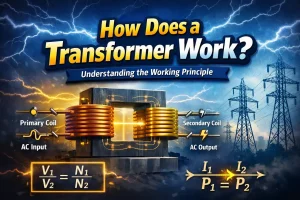
How Does a Transformer Work? A Complete Guide to Transformer Working Principle
Introduction Transformers are one of the most essential components in modern power systems. From large [...]
Feb
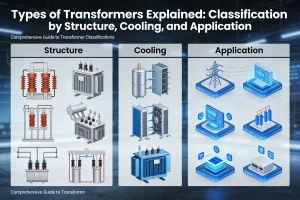
Types of Transformers Explained: Classification by Structure, Cooling, and Application
Introduction Transformers are designed in many different forms to meet the diverse requirements of power [...]
Feb