

Introduction
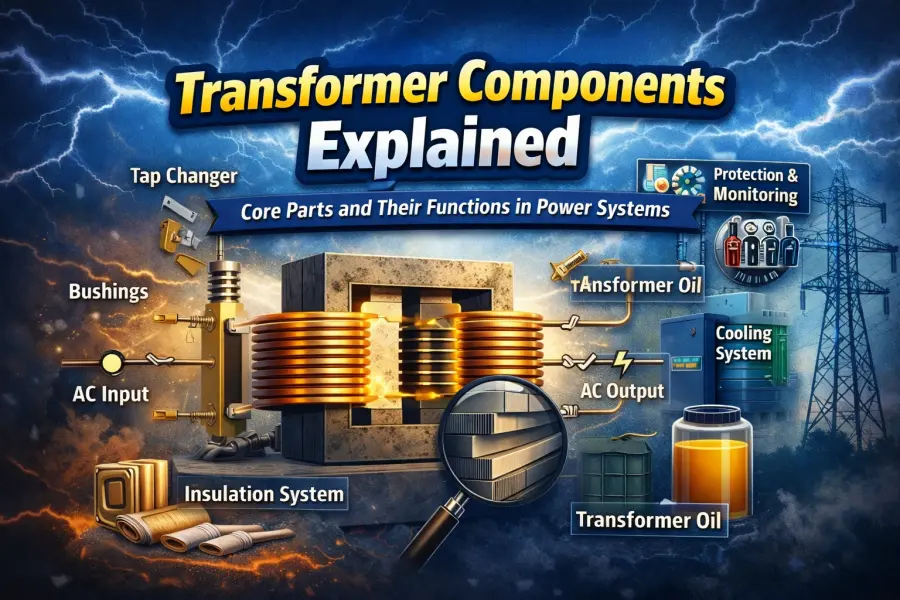
Understanding transformer components is essential for engineers, power utilities, and industrial buyers. While many people know that transformers change voltage levels, fewer understand the internal parts that make this possible.
In this guide, we break down the main parts of a transformer, explain their functions, and show how each component contributes to efficiency, reliability, and long service life in power systems.
1. Transformer Core
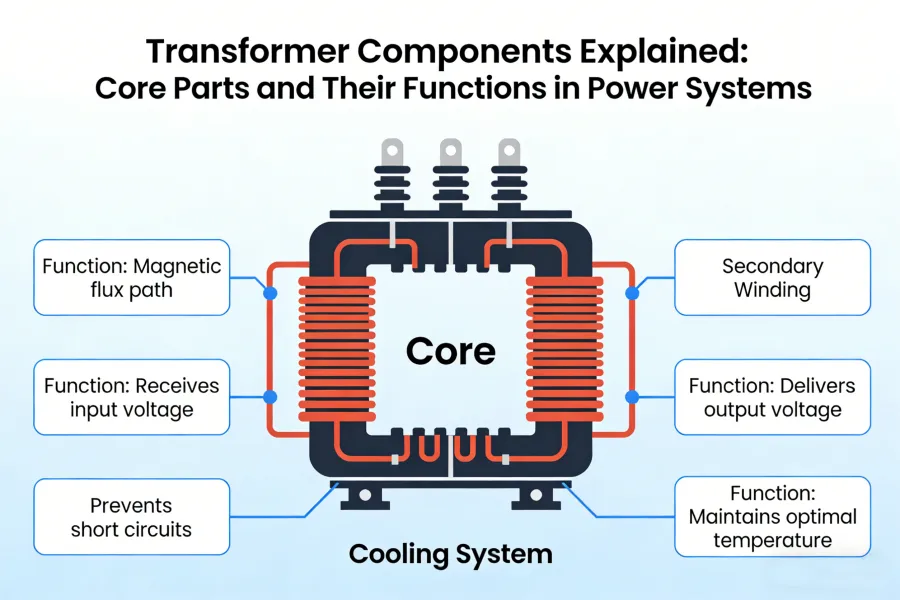
The transformer core is the magnetic heart of the transformer.
Function:
-
Provides a low-reluctance path for magnetic flux
-
Improves magnetic coupling between windings
-
Reduces energy losses
Material:
Most transformer cores are made from:
-
Laminated silicon steel
-
Grain-oriented electrical steel (GO steel)
-
Amorphous metal (for high-efficiency designs)
Why Laminated?
Laminations reduce eddy current losses, which improves transformer efficiency.
2. Primary Winding
The primary winding is connected to the input power source.
Function:
-
Receives AC voltage
-
Generates magnetic flux in the core
-
Determines voltage transformation ratio (with secondary winding)
The number of turns in the primary coil directly affects voltage output.
3. Secondary Winding
The secondary winding delivers power to the load.
Function:
-
Receives induced voltage
-
Supplies output power
-
Works together with primary winding to define turns ratio
In step-up transformers, the secondary has more turns.
In step-down transformers, it has fewer turns.
4. Insulation System
Insulation is one of the most critical components in transformer construction.
Types of Insulation:
-
Paper insulation
-
Pressboard
-
Epoxy resin (dry-type transformers)
-
Transformer oil (liquid insulation)
Function:
-
Prevents electrical short circuits
-
Withstands high voltage stress
-
Maintains dielectric strength
Transformer lifespan largely depends on insulation quality.
5. Transformer Oil (For Oil-Immersed Transformers)
Transformer oil serves dual purposes:
-
Electrical insulation
-
Heat dissipation
Additional Benefits:
-
Reduces oxidation
-
Prevents moisture damage
-
Helps detect internal faults (via dissolved gas analysis)
High-quality mineral oil or natural ester fluids are commonly used.
Read More:How Does a Transformer Work? A Complete Guide to Transformer Working Principle
6. Cooling System
Transformers generate heat due to copper and core losses.
Cooling systems include:
-
ONAN (Oil Natural Air Natural)
-
ONAF (Oil Natural Air Forced)
-
OFAF (Oil Forced Air Forced)
-
Air-cooled systems (dry type)
Proper cooling extends transformer life and improves performance.
7. Bushings
Bushings allow electrical conductors to pass safely through the transformer tank.
Function:
-
Provide insulation between conductor and grounded tank
-
Prevent flashover
-
Withstand mechanical and thermal stress
Bushings are critical for high-voltage applications.
8. Tap Changer
Tap changers adjust output voltage.
Types:
-
Off-load tap changer (OLTC manual adjustment)
-
On-load tap changer (OLTC automatic adjustment)
They help maintain stable voltage despite load fluctuations.
Learn More:Types of Transformers Explained: Classification by Structure, Cooling, and Application
9. Transformer Tank and Enclosure
The tank protects internal components.
Functions:
-
Holds transformer oil
-
Provides structural strength
-
Protects from environmental conditions
Outdoor transformers use weather-resistant coatings.
10. Protection and Monitoring Devices
Modern transformers include:
-
Buchholz relay
-
Pressure relief device
-
Temperature sensors
-
Oil level indicators
-
Gas monitoring systems
These components enhance operational safety and reliability.
How Transformer Components Work Together
Each component plays a specific role:
-
Core transfers magnetic flux
-
Windings convert voltage
-
Insulation prevents breakdown
-
Cooling system removes heat
-
Protection devices ensure safety
A failure in one component can affect the entire system.
Learn More:Transformer Basics: Working Principle, Structure, and Role in Power Systems
Why Understanding Transformer Parts Matters for Buyers
For industrial buyers and EPC contractors, knowing transformer components helps:
-
Evaluate product quality
-
Compare manufacturers
-
Ensure compliance with IEC / IEEE standards
-
Improve long-term asset performance
Transformer construction quality directly impacts:
-
Efficiency
-
Service life
-
Maintenance cost
-
Operational reliability
FAQ
What is the most important part of a transformer?
The core and windings are fundamental, but insulation system quality often determines lifespan.
Why is transformer oil important?
It provides insulation and cooling simultaneously.
What material is best for transformer cores?
Grain-oriented silicon steel is commonly used for high-efficiency power transformers.
Conclusion
Transformer components work together to safely and efficiently transfer electrical energy in power systems. From the magnetic core to insulation and cooling systems, each part plays a critical role in performance and reliability.
Understanding these components helps engineers design better systems and helps buyers select high-quality transformers for industrial and utility applications.