

Introduction
Transformers are essential equipment in modern electrical power systems. They enable electricity to be transmitted, distributed, and utilized at appropriate voltage levels while maintaining high efficiency and system safety.
For engineers, EPC contractors, and industrial buyers, understanding transformer fundamentals helps ensure correct selection, reliable operation, and long service life. This article introduces the basic working principle, main structure, and practical role of transformers, using clear engineering language suitable for real-world applications.
What Is a Transformer?
A transformer is a static electrical device that transfers electrical energy between circuits through electromagnetic induction. It changes voltage levels without altering the system frequency.
In power systems, transformers are mainly used to:
-
Step voltage up or down
-
Provide electrical isolation
-
Improve transmission efficiency
-
Protect equipment and personnel
Transformers operate only with alternating current (AC). Direct current cannot produce the changing magnetic field required for transformer operation.
Basic Working Principle of a Transformer
When an AC voltage is applied to the primary winding, it creates an alternating magnetic flux in the transformer core. This magnetic flux links the secondary winding and induces a voltage at the secondary terminals.
The voltage relationship between the primary and secondary sides depends on the number of turns in each winding.
Primary voltage / Secondary voltage = Primary turns / Secondary turns
Where:
-
Primary voltage is the voltage applied to the primary winding
-
Secondary voltage is the voltage obtained from the secondary winding
-
Primary turns represent the number of turns on the primary winding
-
Secondary turns represent the number of turns on the secondary winding
If the secondary winding has fewer turns than the primary winding, the transformer reduces the voltage.
If the secondary winding has more turns than the primary winding, the transformer increases the voltage.
Main Components of a Power Transformer
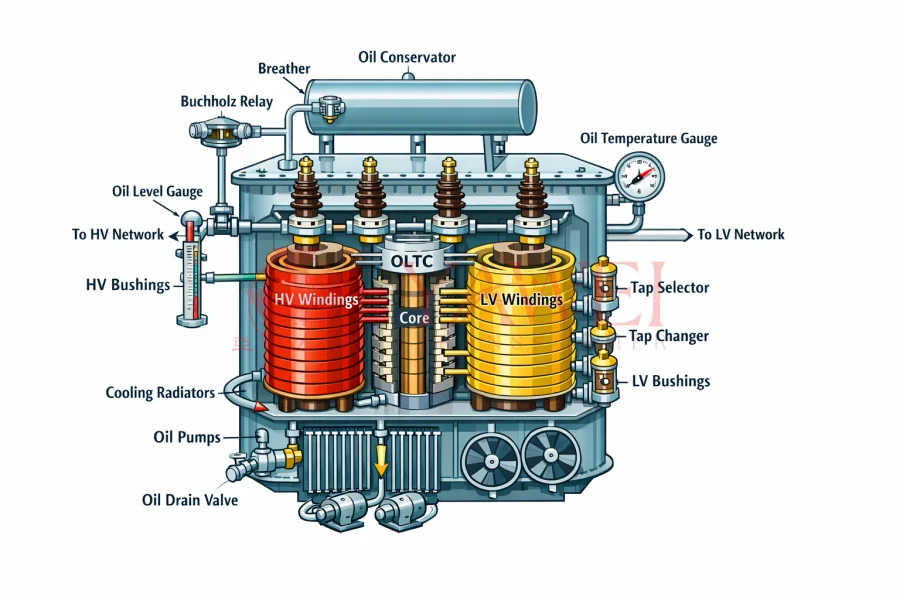
Although transformer designs vary by rating and application, most power and distribution transformers share the same basic components.
Transformer Core
The core provides a low-reluctance path for magnetic flux and helps reduce energy losses.
-
Typically made of laminated silicon steel
-
Laminations reduce eddy current losses
-
Common core structures include core-type and shell-type designs
Windings
Transformers have primary and secondary windings made of copper or aluminum conductors.
-
Designed to carry rated current safely
-
Insulated to withstand electrical, thermal, and mechanical stresses
-
Winding arrangement affects impedance, losses, and short-circuit performance
Insulation System
The insulation system ensures electrical separation between windings and grounded parts.
-
Solid insulation materials include paper, pressboard, and epoxy
-
Liquid insulation in oil-filled transformers also provides cooling
-
Insulation quality directly affects transformer lifespan
Cooling System
Heat is generated during transformer operation due to core and winding losses. Cooling systems are used to control temperature rise.
Common cooling methods include:
-
Oil natural air natural
-
Oil natural air forced
-
Air-cooled dry-type systems
Tank and Accessories
Oil-filled transformers are housed in steel tanks and equipped with essential accessories such as:
-
High-voltage and low-voltage bushings
-
Tap changers for voltage adjustment
-
Temperature indicators and pressure protection devices
Role of Transformers in Power Systems
Transformers play a critical role in ensuring efficient and safe power delivery.
Voltage Control and Transmission Efficiency
High-voltage transmission reduces current and minimizes line losses. Transformers allow voltage to be stepped up at power plants and stepped down near load centers, making long-distance power transmission practical.
Electrical Isolation and System Protection
By electrically isolating circuits, transformers improve system safety, reduce fault impact, and protect downstream equipment.
System Flexibility
Different transformer ratings and configurations allow power systems to serve diverse loads, expand capacity, and adapt to future requirements.
Transformer Losses and Efficiency Overview
Transformers are highly efficient devices, often achieving efficiencies above 95 percent.
Main loss categories include:
-
Core losses, which occur even without load
-
Winding losses, which increase with load current
-
Additional losses caused by stray magnetic flux and mechanical effects
Proper design, material selection, and cooling are essential to minimize these losses.
Common Applications of Transformers
Transformers are widely used in:
-
Power generation and substations
-
Transmission and distribution networks
-
Industrial plants and manufacturing facilities
-
Commercial buildings and infrastructure projects
-
Renewable energy systems such as solar and wind power
Conclusion
Transformers are fundamental to modern electrical systems. While their operating principle is simple, reliable performance depends on precise design, high-quality materials, and strict manufacturing control.
As a professional manufacturer, Yawei Transformer provides power and distribution transformers designed to meet international standards and real operating conditions, supporting stable, efficient, and long-term power system operation.