

Introduction
Transformers are designed in many different forms to meet the diverse requirements of power systems. While the basic working principle remains the same, transformer designs vary significantly depending on voltage level, capacity, installation environment, cooling method, and application.
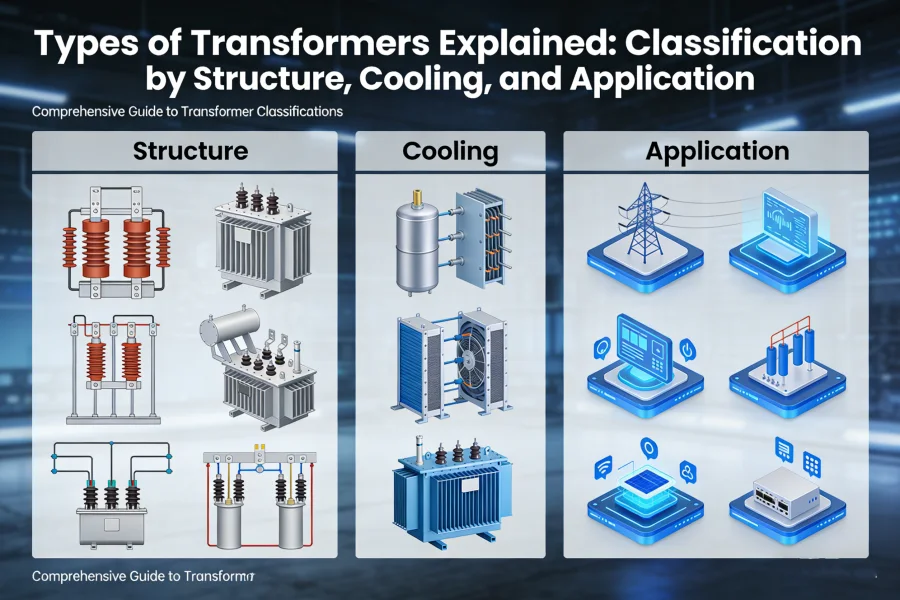
Understanding the different types of transformers helps engineers, EPC contractors, and industrial users select the most suitable solution for reliable and efficient power system operation. This article provides a clear classification of transformers based on structure, cooling method, and application, with practical explanations for each category.
Classification of Transformers by Function
Step-Up Transformers
Step-up transformers increase voltage from the primary side to the secondary side. They are commonly used in power generation plants to raise voltage levels for long-distance transmission.
Higher transmission voltage reduces current, which minimizes line losses and improves overall system efficiency.
Step-Down Transformers
Step-down transformers reduce voltage to levels suitable for distribution and end users. These transformers are widely used in substations, industrial facilities, and commercial power systems.
They ensure safe voltage levels for equipment and personnel.
Isolation Transformers
Isolation transformers provide electrical separation between circuits without significantly changing voltage levels.
They are commonly used to:
-
Improve safety
-
Reduce electrical noise
-
Protect sensitive equipment
Classification by Phase
Single-Phase Transformers
Single-phase transformers are typically used in:
-
Residential power supply
-
Rural distribution networks
-
Light commercial applications
They are simple in structure and cost-effective for low-capacity systems.
Three-Phase Transformers
Three-phase transformers are used in:
-
Industrial power systems
-
Utility substations
-
Large commercial and infrastructure projects
They offer higher efficiency and better load balance for high-capacity applications.
Classification by Cooling Method
Cooling is a critical factor affecting transformer performance, lifespan, and reliability.
Oil-Immersed Transformers
Oil-immersed transformers use insulating oil for both insulation and heat dissipation.
Common advantages include:
-
High cooling efficiency
-
Suitable for medium and high power ratings
-
Long service life
Typical cooling methods include oil natural air natural and oil natural air forced systems.
Dry-Type Transformers
Dry-type transformers use air or solid insulation instead of oil.
They are commonly installed:
-
Indoors
-
In environmentally sensitive areas
-
Where fire safety is a priority
Dry-type transformers generally require less maintenance but are limited in maximum capacity compared to oil-filled designs.
Classification by Core Construction
Core-Type Transformers
In core-type transformers, windings surround the core limbs.
Key features:
-
Simple construction
-
Good mechanical strength
-
Widely used in distribution and power transformers
Shell-Type Transformers
In shell-type transformers, the core surrounds the windings.
Advantages include:
-
Better short-circuit strength
-
Reduced leakage flux
-
Compact design
Shell-type designs are often used for special or high-performance applications.
Classification by Installation Method
Pole-Mounted Transformers
Pole-mounted transformers are installed on utility poles and commonly used in overhead distribution networks.
They are cost-effective and suitable for:
-
Rural areas
-
Low to medium load requirements
Pad-Mounted Transformers
Pad-mounted transformers are installed at ground level in outdoor enclosures.
They are widely used in:
-
Underground distribution systems
-
Residential and commercial developments
Pad-mounted designs improve safety and aesthetics in urban environments.
Substation Transformers
Substation transformers handle higher capacities and voltage levels.
They are critical components in:
-
Transmission substations
-
Industrial substations
-
Grid interconnection points
Classification by Application
Transformers are designed to meet specific application requirements.
Common application categories include:
-
Power transformers for transmission networks
-
Distribution transformers for local power supply
-
Industrial transformers for manufacturing processes
-
Renewable energy transformers for solar and wind power systems
-
Special-purpose transformers for testing, traction, or rectifier systems
Each application requires careful consideration of electrical, thermal, and environmental factors.
How to Choose the Right Transformer Type
Selecting the correct transformer type depends on several key factors:
-
Rated capacity and voltage levels
-
Installation environment
-
Cooling and safety requirements
-
Applicable standards and regulations
-
Future expansion needs
Proper transformer selection improves system reliability and reduces total lifecycle cost.
Conclusion
Transformers are available in a wide range of types to meet different technical and operational requirements. Classifying transformers by structure, cooling method, and application provides a practical framework for understanding their design and use in power systems.
As a professional transformer manufacturer, Yawei Transformer provides customized transformer solutions tailored to specific applications, ensuring reliable performance, compliance with international standards, and long-term operational stability.