










Introduction
Choosing the correct transformer size is one of the most important decisions in electrical power system design. An undersized transformer may lead to overheating, voltage drops, and equipment failure, while an oversized transformer can result in unnecessary investment costs and higher no-load losses.
For engineers, contractors, and industrial facility managers, understanding how to calculate transformer capacity (kVA) is essential to ensure reliable and efficient power distribution.
In this guide, we explain the transformer sizing formula, calculation methods, real examples, and practical considerations used in industrial and commercial power systems.
What Is Transformer kVA Rating?
The capacity of a transformer is typically expressed in kVA (kilovolt-ampere) rather than kW.
This is because transformers deliver apparent power, which includes both:
Active Power (kW) – the real power used by equipment
Reactive Power (kVAR) – power required by inductive loads such as motors
The relationship between them is determined by the power factor (PF).
Power Formula
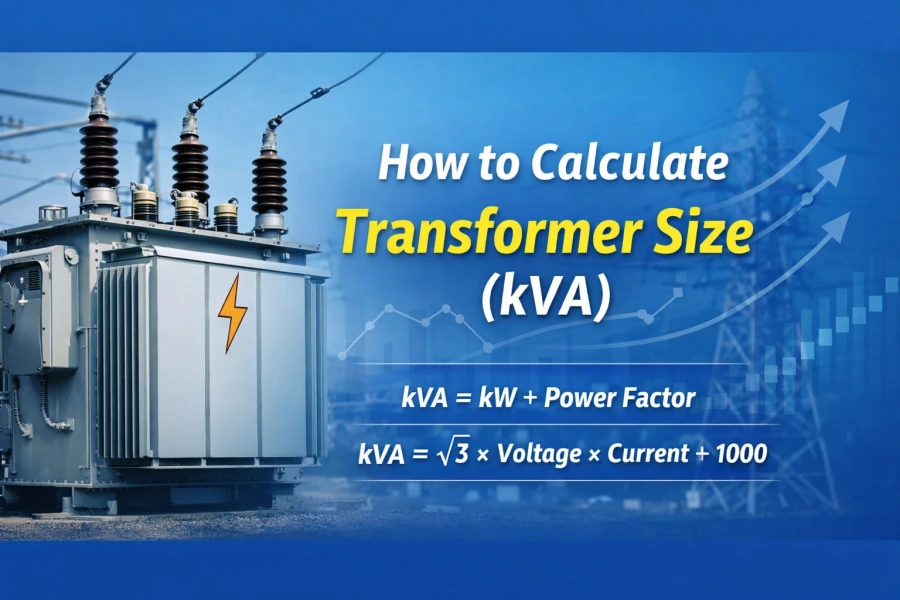
kVA = kW ÷ Power Factor
For example:
Load = 100 kW
Power Factor = 0.8
Transformer size required:
kVA = 100 ÷ 0.8 = 125 kVA
In practice, engineers usually select the next standard transformer rating, such as 150 kVA.
Basic Transformer Sizing Formula
The transformer capacity can also be calculated using voltage and current.
Single-Phase Transformer Formula
kVA = (Voltage × Current) ÷ 1000
Example:
Voltage = 240 V
Current = 100 A
kVA = (240 × 100) ÷ 1000
kVA = 24 kVA
Three-Phase Transformer Formula
For industrial systems, three-phase transformers are commonly used.
kVA = (√3 × Voltage × Current) ÷ 1000
Example:
Voltage = 480 V
Current = 120 A
kVA = (1.732 × 480 × 120) ÷ 1000
kVA ≈ 99.8 kVA
Therefore, a 100 kVA transformer would typically be selected.
Example: Industrial Transformer Sizing Calculation
Let’s look at a practical example.
Industrial Facility Load
Total connected load:
| Equipment | Power |
|---|---|
| Motors | 80 kW |
| Lighting | 20 kW |
| HVAC | 40 kW |
| Equipment | 30 kW |
Total Load:
170 kW
Assume average power factor:
PF = 0.9
Transformer Capacity Calculation
kVA = 170 ÷ 0.9
kVA = 188.9 kVA
Engineers typically add a 20–25% safety margin.
Recommended transformer size:
250 kVA
This allows room for:
load fluctuation
equipment startup current
future expansion
Standard Transformer Sizes Used in Industry
Most manufacturers provide standard transformer ratings.
Typical distribution transformer sizes include:
| Application | Typical Transformer Size |
|---|---|
| Small commercial building | 45 – 75 kVA |
| Retail store | 75 – 150 kVA |
| Medium commercial facility | 150 – 300 kVA |
| Industrial plant | 300 – 1000 kVA |
| Large industrial systems | 1000 kVA – 5000 kVA |
Choosing the correct rating ensures efficient operation and longer transformer life.
Transformer Oversizing vs Undersizing
Undersized Transformer Risks
If the transformer capacity is too small:
overheating
insulation degradation
voltage drop
reduced equipment lifespan
possible transformer failure
This is a common issue in rapidly expanding industrial facilities.
Oversized Transformer Problems
Oversizing also has disadvantages:
higher purchase cost
increased no-load losses
lower efficiency at light loads
Therefore, the best practice is selecting a transformer close to the calculated load with reasonable expansion margin.
Factors That Affect Transformer Capacity Selection
Several factors must be considered when selecting transformer size.
1. Load Type
Different loads behave differently.
Examples:
motors
welding equipment
HVAC systems
variable frequency drives
Motor loads often require higher starting current, which must be considered during sizing.
2. Future Expansion
Industrial facilities often expand over time.
Engineers typically reserve 20–30% additional capacity to support future equipment.
3. Ambient Temperature
High ambient temperature reduces transformer cooling efficiency.
Outdoor transformers operating in hot climates may require higher capacity or improved cooling methods.
4. Harmonic Loads
Modern facilities use many electronic devices:
UPS systems
data centers
VFD drives
These create harmonic distortion, which can increase transformer heating.
In such cases, K-rated transformers or larger capacity may be recommended.
5. Duty Cycle
Continuous loads require more conservative transformer sizing compared to intermittent loads.
For example:
data centers
manufacturing lines
mining operations
These applications often operate 24/7.
Choosing the Right Transformer Type
After determining transformer capacity, the next step is selecting the appropriate transformer type.
Common options include:
Pad-Mounted Transformers
Used in:
commercial buildings
residential distribution
industrial parks
Advantages:
ground level installation
compact design
improved safety
Pole-Mounted Transformers
Common in:
rural power distribution
overhead power lines
Advantages:
low installation cost
simple infrastructure
Substation Transformers
Used in:
utility substations
power plants
large industrial facilities
Advantages:
high capacity
high voltage capability
Typical Transformer Voltage Combinations
Industrial transformers often use the following voltage configurations:
| Primary Voltage | Secondary Voltage |
|---|---|
| 13.8 kV | 480V |
| 33 kV | 400V |
| 34.5 kV | 480V |
| 11 kV | 415V |
The exact configuration depends on the power distribution system design.
Best Practices for Transformer Selection
Electrical engineers typically follow these steps:
Calculate total connected load
Determine system voltage
Calculate required kVA capacity
Add safety margin for expansion
Select appropriate transformer type
Confirm installation environment (indoor / outdoor)
Following these steps helps ensure safe, reliable, and efficient power distribution.
Conclusion
Correct transformer sizing is essential for reliable electrical system performance. Selecting the right transformer capacity helps prevent overheating, reduce losses, and ensure long-term operational stability.
By using the proper kVA calculation formulas, evaluating load characteristics, and considering future expansion, engineers can select the optimal transformer for industrial and commercial applications.
As a professional power transformer manufacturer, Yawei Transformer provides customized transformer solutions for global industrial and utility projects, including:
distribution transformers
pad-mounted transformers
pole-mounted transformers
substation transformers
If you need assistance selecting the right transformer capacity for your project, our engineering team is ready to help provide technical support and customized solutions.