





Introducción
As electricity demand continues to grow across residential, commercial, industrial, and renewable energy projects, reliable power distribution equipment has become increasingly important. A pad mounted transformer provides a compact, secure, and efficient solution for distributing electrical power through underground distribution networks.
En JSYW Transformer Pad Mounted Transformer is designed for outdoor power distribution applications where safety, space efficiency, operational reliability, and convenient maintenance are essential. Available in different capacities, voltage configurations, and electrical designs, pad mounted transformers can be customized to meet the requirements of utility companies, contractors, engineering firms, and industrial users.
Whether supplying electricity to residential communities, commercial buildings, manufacturing facilities, or solar power projects, selecting the right pad mounted transformer is an important step toward building a stable electrical distribution system.
In this article, we explain the working principles, main features, technical considerations, applications, and selection criteria of JSYW pad mounted transformers.
1. What Is a Pad Mounted Transformer?
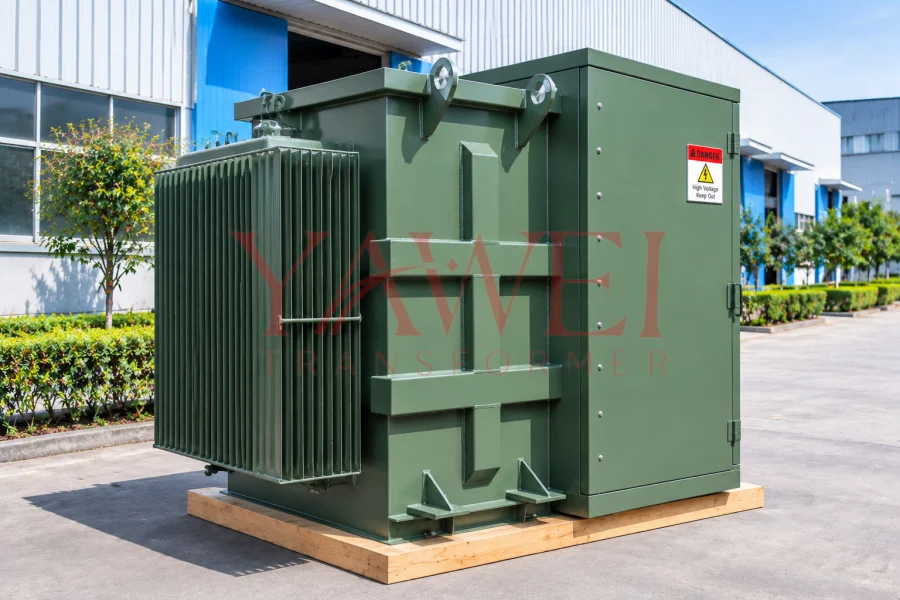
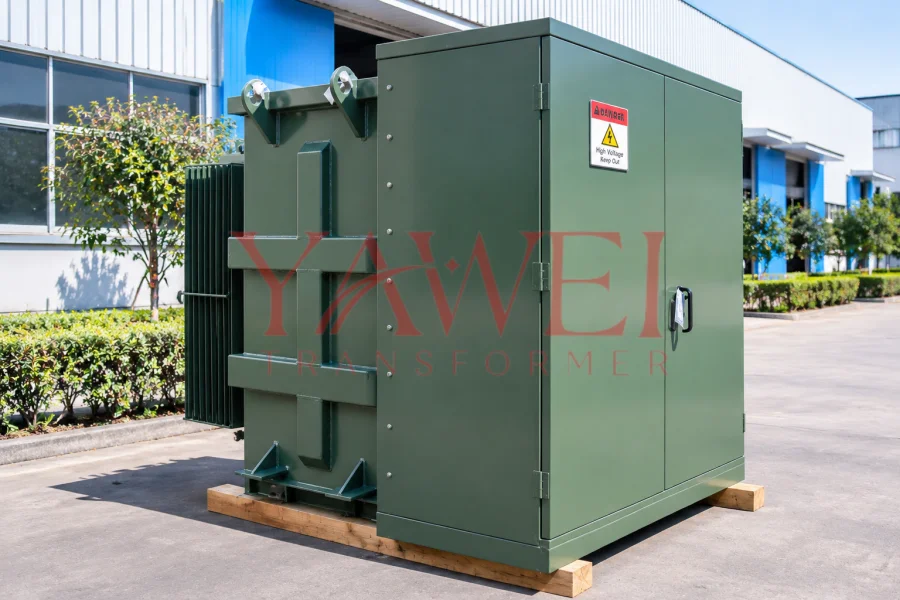
A transformador de pedestal is a liquid-filled transformador de distribución installed on a concrete foundation or equipment pad at ground level. Unlike pole mounted transformers, which are installed overhead, pad mounted units are enclosed in a secure, weather-resistant metal cabinet.
The enclosure typically contains three main sections:
Transformer compartment: Houses the magnetic core, windings, insulating liquid, and cooling components.
High-voltage compartment: Contains primary bushings, cable connections, and switching or protection components.
Low-voltage compartment: Provides secondary connections for distributing electricity to downstream electrical equipment.
This integrated design allows the transformer to connect directly to underground distribution cables while keeping energized components protected from unauthorized access.
Depending on project requirements, pad mounted transformers can be manufactured in single-phase or three-phase configurations, with different primary and secondary voltage ratings.
2. Key Features of JSYW Transformer Pad Mounted Transformer
JSYW Transformer provides pad mounted transformer solutions for utility distribution, commercial developments, industrial facilities, and renewable energy applications.
Important design features include:
Outdoor Weather-Resistant Enclosure
The enclosure is designed for outdoor installation and protects internal electrical components against environmental exposure. Cabinet materials, surface coatings, sealing arrangements, and corrosion protection can be selected according to the installation environment.
For coastal locations or areas with high humidity, additional corrosion protection may be specified.
Compact and Space-Saving Design
Pad mounted transformers combine the transformer body, connection compartments, and associated protective components in one enclosed unit.
This arrangement makes them suitable for locations where underground cable distribution is preferred and available installation space is limited.
Safe and Secure Operation
A properly designed pad mounted transformer uses compartmentalized construction, locking mechanisms, and suitable electrical insulation to reduce the risk of accidental contact with energized components.
Dead-front configurations are commonly selected for applications requiring insulated, shielded high-voltage connections.
Flexible Electrical Configurations
JSYW pad mounted transformers can be configured according to project requirements, including:
Single-phase and three-phase designs.
Radial-feed and loop-feed configurations.
Copper or aluminum windings.
Different primary and secondary voltages.
Customized impedance and voltage tap arrangements.
Different protection and accessory configurations.
The final design should be confirmed against the customer’s electrical specifications and applicable standards.
3. Technical Specifications and Available Configurations
Choosing the correct transformer requires more than selecting a rated capacity. Voltage ratings, frequency, winding material, impedance, insulation level, cooling method, and connection arrangements all influence transformer performance.
The following table provides an overview of common configuration considerations.
These are indicative configuration options, not a guarantee that every combination is available as a standard model. Actual ratings and design details must be confirmed through engineering review.
For North American projects, buyers should pay particular attention to applicable ANSI, IEEE, UL, and local utility requirements. Relevant standards may include IEEE C57.12.34 and other applicable transformer standards, depending on the equipment design and rating.
4. Applications of Pad Mounted Transformers
Pad mounted transformers are widely used in distribution systems that require ground-level installation and underground cable connections.
Residential Communities
Residential developments require dependable electricity for homes, lighting, elevators, and common facilities. Pad mounted transformers can be distributed throughout residential areas to supply local electrical loads.
Edificios comerciales
Shopping centers, office buildings, hotels, hospitals, and educational facilities often use pad mounted transformers to support their medium-voltage distribution networks.
Their enclosed construction makes them suitable for outdoor installation near buildings and electrical service areas, subject to proper clearance and safety requirements.
Instalaciones industriales
Factories, warehouses, processing plants, and manufacturing facilities require stable electrical power for production machinery and auxiliary systems.
Pad mounted transformers can be designed with suitable capacity, impedance, and voltage configurations to match industrial load requirements.
Proyectos de energía solar y renovable
Solar farms and battery energy storage systems require transformers to connect electrical equipment to medium-voltage collection networks.
Depending on the system architecture, pad mounted transformers can be used as distribution transformers or designed for step-up applications between inverters and the collection grid.
Centros de datos
Data centers require reliable electrical infrastructure to support critical IT equipment, cooling systems, and backup power arrangements.
Pad mounted transformers can serve as part of an underground medium-voltage distribution network, with capacity and redundancy determined by the overall electrical design.
5. How to Choose the Right Pad Mounted Transformer
Selecting a suitable transformer requires coordination between the purchaser, electrical engineer, and manufacturer.
Before requesting a quotation, consider the following factors.
1. Rated Capacity (kVA)
Determine the expected maximum demand, load characteristics, and future expansion requirements. Transformer capacity should account for operating conditions and appropriate engineering margins.
2. Primary and Secondary Voltage
Confirm the incoming medium-voltage supply and required secondary voltage. Common North American distribution voltages include 13.2 kV, 13.8 kV, 24.9 kV, and 34.5 kV, but the actual system voltage must be verified.
3. Single-Phase or Three-Phase
The choice depends on the electrical distribution system and connected loads. Three-phase transformers are widely used in commercial and industrial applications, while single-phase units can serve specific residential and distribution requirements.
4. Copper or Aluminum Windings
Copper windings offer high electrical conductivity and compact winding designs. Aluminum windings can provide a cost-effective alternative. The final selection should consider losses, dimensions, operating conditions, and total ownership cost.
5. Protection and Connection Requirements
Confirm whether the project requires radial-feed or loop-feed construction, dead-front or live-front connections, internal fuses, load-break switches, surge arresters, and other accessories.
6. Applicable Standards
Different markets have different regulatory and technical requirements. Confirm the applicable ANSI/IEEE, IEC, UL, CSA, or local utility specifications before manufacturing begins.
6. Why Work with JSYW Transformer?
Choosing a transformer manufacturer is not simply about comparing purchase prices. Engineering capability, manufacturing quality, testing procedures, customization, and technical communication are equally important.
JSYW Transformer focuses on power and distribution transformer solutions for utility, industrial, renewable energy, and infrastructure applications.
Customers can benefit from:
Factory-direct supply: Access to manufacturing resources and technical communication.
Customized engineering: Transformer designs based on project-specific electrical requirements.
Product variety: Single-phase, three-phase, oil-immersed, and other transformer solutions.
Quality control: Manufacturing inspections and electrical testing according to the agreed specifications.
International project support: Technical documentation and export coordination for overseas customers.
For projects involving North American specifications, customers should confirm the required certification, listing, testing, and documentation for the exact transformer configuration before placing an order.
7. What Information Is Required for a Pad Mounted Transformer Quotation?
To prepare an accurate quotation, buyers should provide as much of the following information as possible:
Rated capacity: kVA.
Number of phases: single-phase or three-phase.
Primary voltage and secondary voltage.
Frequency: 50 Hz or 60 Hz.
Winding material: copper or aluminum.
Impedance percentage.
Vector group or connection configuration.
Radial-feed or loop-feed arrangement.
Required accessories and protection devices.
Applicable standards and certification requirements.
Installation environment and enclosure requirements.
Delivery destination and expected delivery schedule.
If complete technical specifications are not available, buyers can also provide an existing transformer nameplate, electrical single-line diagram, or project specification for preliminary engineering evaluation.
8. Frequently Asked Questions
Q1: What is the difference between a pad mounted transformer and a pole mounted transformer?
A pad mounted transformer is installed at ground level inside a protective cabinet and is commonly connected to underground cables. A pole mounted transformer is installed overhead on a utility pole and is generally associated with overhead distribution networks.
Q2: Are JSYW pad mounted transformers available in three-phase designs?
Yes. Three-phase pad mounted transformer configurations are available for commercial, industrial, utility, and renewable energy applications. Capacity and voltage ratings depend on the project requirements.
Q3: Can a pad mounted transformer be customized?
Yes. Important design parameters, including rated capacity, voltage, winding material, impedance, connection arrangement, cabinet dimensions, and accessories, can be specified according to the project.
Q4: Are pad mounted transformers suitable for solar power projects?
Yes. They can be designed for suitable solar and battery energy storage applications. The required voltage ratio, power rating, duty cycle, and grid connection requirements should be confirmed during engineering.
Q5: What standards should buyers consider?
For North American projects, applicable ANSI and IEEE standards are important. UL or CSA certification may also be required depending on the project, jurisdiction, and purchaser’s specifications. Always verify the exact compliance requirements before ordering.
Conclusion: Find the Right Pad Mounted Transformer for Your Project
A reliable pad mounted transformer is an essential component of modern underground electrical distribution systems. From residential developments and commercial facilities to industrial plants and renewable energy projects, the right transformer design helps ensure safe, stable, and efficient power delivery.
JSYW Transformer offers pad mounted transformer solutions with flexible electrical configurations and project-oriented engineering support.
Whether you need a single-phase distribution transformer, a three-phase pad mounted transformer, or a customized medium-voltage solution, providing clear technical specifications is the first step toward obtaining an accurate quotation.
Contact JSYW Transformer to discuss your project requirements, request technical specifications, and receive a customized pad mounted transformer quotation.