








Yawei Transformer Glossary A–Z
This glossary page provides a comprehensive A–Z index of over 100 transformer-related terms, including specialized vocabulary for UHV transformers, 500kV systems, 1200MVA units, and global power transmission contexts. Each entry includes detailed explanations for SEO-rich content, technical clarity, and industry relevance.
A
Ambient Temperature: The surrounding temperature where the transformer operates. Critical for calculating transformer ratings, thermal performance, and insulation life, especially in UHV 500kV and 1200MVA units.
Air Insulated Switchgear (AIS): Switchgear using air as the primary insulation medium. Often paired with high-voltage transformers for utility substations.
Auto-transformer: A transformer with a single winding that acts as both primary and secondary. Used for voltage regulation in high-capacity systems.
Ampere (A): Unit of electric current. Essential for calculating transformer load, thermal limits, and current carrying capacity.
Active Power (P): The real power delivered by a transformer, measured in watts or megawatts. Determines transformer sizing in large-scale UHV projects.
B
BIL (Basic Insulation Level): A standard defining transformer insulation capability against voltage surges. Key in 500kV and UHV transformer designs.
Breakdown Voltage: The voltage at which transformer insulation fails. Critical for safety, reliability, and long-term operation.
Busbar: Conductors used to connect transformers to distribution or transmission networks, enabling multiple circuits.
Bushings: Insulated devices allowing conductors to pass through transformer tanks safely. High-voltage bushings are critical for 500kV and UHV systems.
Bypass Switch: A switch used to divert current around a transformer for maintenance or operational flexibility.
C
Cooling Oil: Mineral or synthetic oil used in oil-immersed transformers for heat dissipation. Important in UHV 500kV transformers for maintaining safe temperature rise.
Core: The magnetic core of a transformer that guides flux and reduces losses. Constructed from high-grade silicon steel.
Current Transformer (CT): Device that scales down high currents for measurement and protection systems.
Conservator Tank: Oil expansion tank for transformers allowing volume changes due to thermal expansion.
Capacitive Voltage Transformer (CVT): Measures high voltage for metering and protection in transmission networks.
D
Delta Connection (Δ): Transformer winding configuration forming a closed loop. Common in three-phase systems.
Dielectric Strength: Measure of insulation’s ability to withstand voltage stress. Vital for UHV transformers.
Distribution Transformer: Transforms medium voltage to low voltage for final delivery to consumers.
Damping: Methods to reduce oscillations or mechanical vibrations in transformer windings.
Direct Current (DC): Flow of electric charge in one direction. Special transformers convert AC to DC for industrial applications.
E
Eddy Currents: Circulating currents in transformer cores causing energy loss. Minimized with laminated cores.
Energy Efficiency: Measurement of input power versus output power. High-efficiency designs reduce losses in 1200MVA transformers.
Excitation Current: Current required to magnetize the transformer core, influencing no-load losses.
Electrical Insulation: Material preventing current flow between conductive parts. Essential in all transformer classes.
Earth Fault: Short circuit between phase and ground. Protection devices rely on CTs and relays to detect and isolate faults.
F
Feeder: Conductor delivering power from the transformer to distribution circuits.
Frequency (Hz): Alternating current cycles per second. Transformers designed for standard frequencies (50Hz or 60Hz).
Furnace Transformer: Special-purpose transformer for electric furnaces, designed for high short-circuit currents.
Fluid-Immersed Transformer: Transformer immersed in dielectric fluid, usually mineral oil, for cooling and insulation.
Fault Current: High current during short circuits; transformer and switchgear ratings must consider this for safety.
G
Generator Step-Up Transformer (GSU): Connects power generators to the high-voltage transmission network, stepping up voltage to 500kV or higher.
Grounding Transformer: Provides neutral grounding in ungrounded systems to stabilize voltage and limit fault currents.
Grid Stability: Ability of the power system to maintain consistent voltage and frequency under varying loads and faults.
Gas-Insulated Transformer (GIT): Transformers using SF6 or other insulating gases, often in compact urban substations.
Gap Cooling: Method to improve heat dissipation in transformers by designing airflow or fluid gaps.
H
Harmonics: Voltage or current deviations from pure sine waves, impacting transformer heating and lifetime.
HV (High Voltage): Generally 66kV–220kV; UHV refers to voltages like 500kV.
Hot-Spot Temperature: Maximum temperature within transformer windings, used to determine aging and insulation life.
Hybrid Transformer: Transformer combining multiple core or winding technologies to optimize efficiency.
Hydraulic Control: Systems regulating tap changers and cooling oil circulation in large transformers.
I
Impedance (Z): Opposition to AC current flow, determining short-circuit currents and voltage drop.
Insulating Oil: Fluid providing dielectric strength and cooling. Key for 500kV oil-immersed units.
Insulation Class: Rating of temperature tolerance of transformer insulation.
Isolation Transformer: Provides galvanic separation between circuits for safety or voltage matching.
Intelligent Monitoring: Digital sensors for real-time transformer diagnostics and predictive maintenance.
J
Joule Losses: Heat losses due to resistance in windings, calculated for efficiency improvement.
Jacket Cooling: Cooling method where oil circulates in an external jacket around transformer windings.
Jumpers: Short conductors used to connect transformer terminals to busbars or circuits.
Jointing: Proper connection of windings, leads, and terminals to reduce resistance and heating.
Junction Box: Protective enclosure for transformer connections and control devices.
K
KVA Rating: Transformer apparent power capacity, critical for sizing in 500kV, 1200MVA installations.
K-factor: Transformer rating for handling non-linear loads, protecting against harmonic heating.
Kilovolts (kV): Voltage unit. 500kV and above is considered UHV.
Keyed Tap Changer: Mechanically selected tap changer for voltage regulation.
Kelvin Measurement: Temperature measurement at specific points, often for winding hot spots.
L
Load Tap Changer (LTC): Adjusts transformer output voltage under load conditions, essential in large grids.
Leakage Reactance: Reactance due to flux leakage; affects voltage regulation.
Liquid-Filled Transformer: Transformer immersed in dielectric oil for insulation and cooling.
Line Drop Compensation: LTC control to maintain voltage at distribution endpoints.
Lightning Impulse Test: Tests transformer insulation against transient voltage surges.
M
Magnetic Core: Core guiding flux; reduces hysteresis and eddy current losses.
Magnetizing Current: Current required to establish flux in transformer core.
Medium Voltage (MV): 1kV–35kV range for distribution transformers.
Moisture Content: Water in insulation or oil reduces dielectric strength; critical for UHV transformer reliability.
Maintenance Schedule: Planned inspection, testing, and servicing to extend transformer life.
N
Neutral Point: Connection point of three-phase transformer windings; grounding affects fault protection.
No-Load Losses: Losses when transformer operates without load; minimized in high-efficiency designs.
Noise Level: Audible transformer noise; compliance needed for urban installations.
NEMA Standards: North American regulatory standards for electrical equipment.
Nominal Voltage: Standard voltage rating for system compatibility.
O
Oil Preservation System: Maintains oil volume and prevents moisture ingress.
Open Delta (V-Connection): Two-transformer configuration to supply three-phase power when one unit is unavailable.
Overload Capacity: Transformer ability to handle temporary excess load.
Overvoltage Protection: Devices or design features preventing insulation failure.
Outdoor Transformer: Designed for open-air installations with weatherproof enclosures.
P
Partial Discharge (PD): Localized insulation breakdown; early indicator of potential transformer failure.
Power Factor: Ratio of active to apparent power; impacts transformer efficiency.
Protective Relay: Device triggering circuit breakers under fault conditions.
Phase Shift: Voltage angle difference between primary and secondary; important for load sharing.
Pulley Cooling: Mechanical system driving fans for forced cooling.
Q
Quality Assurance (QA): Systematic process ensuring transformers meet specifications.
Quick Tap Change: Fast adjustment of voltage using on-load tap changer.
Quenching: Cooling process to prevent overheating in special-purpose transformers.
Quantity of Oil: Correct volume ensures optimal cooling in large-capacity transformers.
Quarter-Wave Resonance: Electrical resonance issue considered in HV design.
R
Capacidad nominal: Maximum designed load a transformer can carry.
Rated Voltage: Nominal voltage at which transformer operates efficiently.
Reactive Power (Q): Non-working power influencing voltage regulation.
Rectifier Transformer: Converts AC to DC for industrial and traction applications.
Regulation: Voltage change under load; critical for system stability.
S
Short-Circuit Impedance: Determines fault current and voltage drop.
Substation Transformer: Transformers installed in substations for voltage step-up/down.
Saturated Core: Core operating beyond linear flux; increases losses and heating.
SF6 Insulated Transformer: Uses sulfur hexafluoride gas for insulation, common in compact urban installations.
Step-Up Transformer: Increases voltage from generator output to transmission levels, e.g., 500kV.
T
Tap Changer: Adjusts voltage by changing winding connections.
Thermal Rating: Maximum temperature transformer can withstand safely.
Three-Phase Transformer: Common in transmission and distribution networks.
Transformer Oil Testing: Ensures dielectric strength and contamination levels are acceptable.
Tripping Mechanism: Activates breaker during fault conditions.
U
UHV (Ultra-High Voltage): Voltage levels above 800kV AC; specialized design required.
Unbalanced Load: Unequal phase loading; affects transformer losses and efficiency.
Upstream Network: Portion of the grid supplying transformer primary side.
Under-Load Tap Changer (ULTC): Adjusts voltage while transformer is operating.
Utility-Grade Transformer: Designed for high reliability and long life in power grids.
V
Vector Group: Defines winding connection type and phase displacement.
Regulación de la tensión: Control of output voltage under varying loads.
Vacuum Circuit Breaker (VCB): Switchgear for high-voltage protection.
Ventilation: Forced or natural air movement for cooling dry-type transformers.
Voltage Class: Standardized rating for transformer insulation.
W
Winding Resistance: Electrical resistance of transformer windings.
Watt Loss: Power loss due to resistance and core losses.
Water-Cooled Transformer: Cooling using water for large capacity or specialized installations.
Waveform Distortion: Non-sinusoidal waveform affecting transformer operation.
Wind Farm Transformer: Custom transformer for renewable energy integration.
X
X/R Ratio: Ratio of reactance to resistance; affects short-circuit calculations.
X-mer Transformer: Special designation for experimental or prototype transformers.
XHV (Extra-High Voltage): Voltages from 345kV to 800kV; above HV and MV.
X-Phase Shift: Phase angle modification for power flow optimization.
X-Connected Windings: Custom winding connection to manage harmonics and load sharing.
Y
Y-Delta Connection: Winding configuration combining star and delta for phase balancing.
Yyn0 Transformer: Common distribution transformer vector group.
Yield Strength: Mechanical property of transformer tank material.
Yearly Maintenance: Routine checks for reliability and extended transformer life.
Yellow Oil Indicator: Visual sign for oil quality and contamination.
Z
Zinc-Coated Tank: Corrosion-resistant transformer enclosure.
Zero Sequence Current: Ground fault current measurement.
Zone Protection: Protective relay arrangement isolating faulted section.
Zig-Zag Transformer: Used for grounding and phase-shifting.
Z-Phase Monitoring: Measurement for advanced diagnostics and fault detection.
Latest News
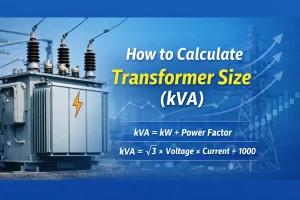
Cómo calcular el tamaño del transformador (kVA): Guía completa para sistemas eléctricos industriales y comerciales
Introducción La elección del tamaño correcto del transformador es una de las decisiones más importantes en [...]
Mar
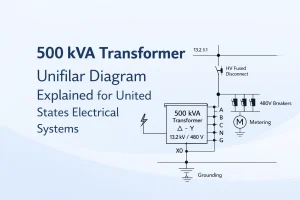
Transformador de 500 kVA Diagrama Unifilar Explicado para Sistemas Eléctricos de Estados Unidos
Introducción En el diseño de la distribución de energía eléctrica, los ingenieros utilizan con frecuencia un diagrama unifilar (también llamado [...]
Mar
Cómo elegir el transformador de alta tensión adecuado: Análisis de capacidad, pérdidas y eficiencia
Guía completa de ingeniería para empresas de servicios públicos, contratistas EPC y compradores industriales Seleccionar el [...]
Febrero
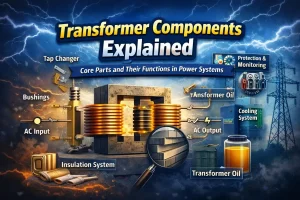
Explicación de los componentes del transformador: Componentes principales y sus funciones en los sistemas de potencia
Introducción Comprender los componentes de los transformadores es esencial para los ingenieros, las compañías eléctricas y los compradores industriales. Aunque muchos [...]
Febrero