




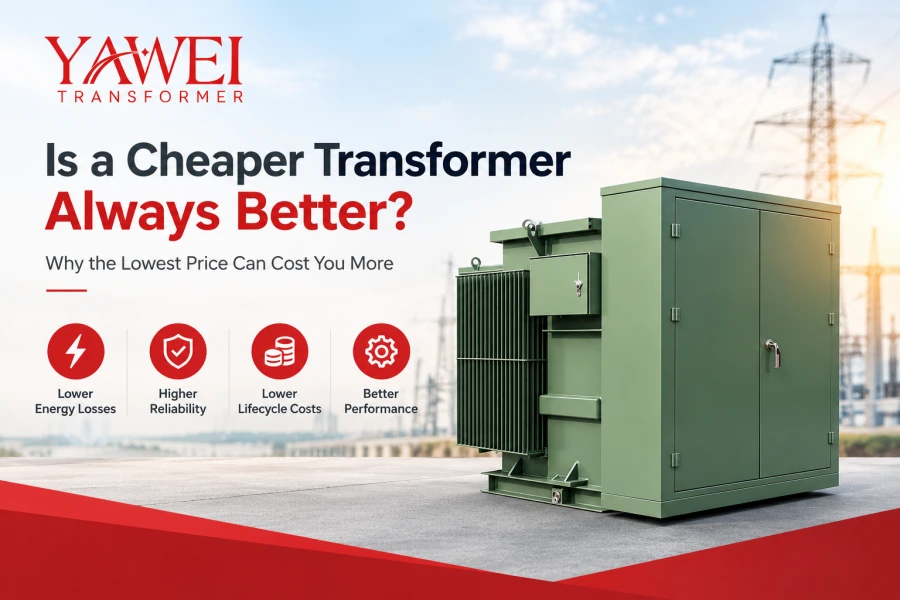
When purchasing a power transformer, price is often one of the first factors buyers compare. For EPC contractors, electrical distributors, industrial facilities, utilities, and renewable energy developers, obtaining a competitive quotation is important. However, choosing a transformer based only on the lowest initial price can lead to higher operating costs, unexpected maintenance expenses, and project risks over time.
So, is a cheaper transformer always better?
The answer is no. The best transformer is not necessarily the cheapest or the most expensive one, but the one that meets the project’s technical requirements and delivers the best overall value throughout its service life.
Understanding the differences between transformer prices, energy losses, manufacturing quality, and lifecycle costs can help buyers make more informed purchasing decisions.
1. Why Do Transformers with Similar Specifications Have Different Prices?
Two transformers with the same rated capacity and nominal voltage can have significantly different quotations. This does not automatically mean that one manufacturer is overcharging or that the cheaper product is inferior.
Transformer pricing depends on several technical and commercial factors.
Core and winding materials
The type and quality of electrical steel used in the transformer core affect no-load losses. Winding materials, conductor cross-section, and winding design influence load losses, temperature rise, and manufacturing costs.
Copper and aluminum windings, for example, have different electrical and physical characteristics. The appropriate choice depends on the design, specifications, applicable standards, and project requirements.
Guaranteed loss requirements
A transformer designed to meet stricter loss limits may require more advanced materials, additional active material, or an optimized magnetic circuit and winding design. These choices can increase the initial manufacturing cost while reducing energy losses during operation.
Voltage level and insulation requirements
A 33 kV transformer is not equivalent to an 11 kV transformer simply because both have the same rated capacity. Insulation coordination, dielectric clearances, bushings, accessories, and testing requirements can differ substantially.
Accessories, testing, and documentation
On-load tap changers, temperature monitoring, protection devices, special enclosures, factory acceptance tests, and project-specific documentation can all affect the final quotation.
Therefore, buyers should compare transformers against the same technical specification rather than relying on capacity and voltage alone.
2. The Hidden Cost of Transformer Energy Losses
One of the most important factors in transformer purchasing is energy loss.
Transformers experience two principal types of electrical losses: no-load losses and load losses.
No-load losses
No-load losses primarily occur in the transformer core when the unit is energized. They remain present even when the transformer supplies little or no load.
This means that a transformer connected to the electrical system for long periods continues to consume energy through its core losses.
Load losses
Load losses are mainly associated with current flowing through the windings and other load-dependent effects. They increase as the transformer carries more load and are approximately proportional to the square of the current under comparable operating conditions.
For example, if the load current increases to 80% of rated current, the winding-related load losses are approximately 64% of their rated-current value, assuming the same reference conditions.
For transformers operating continuously over many years, even relatively small differences in guaranteed losses can accumulate into substantial operating expenses.
The United Nations Environment Programme’s United for Efficiency initiative provides guidance on evaluating transformer purchases using total cost of ownership, including the capitalized cost of future energy losses.
3. Initial Purchase Price vs. Total Cost of Ownership
The initial quotation is only one component of the total cost of owning a transformer.
A more comprehensive evaluation considers the total cost of ownership (TCO), which can include:
- Initial equipment purchase price.
- Electricity costs associated with no-load and load losses.
- Transportation, insurance, installation, and commissioning.
- Routine maintenance and spare parts.
- Potential downtime, repair, and replacement costs.
- Applicable disposal costs at the end of the service life.
A simplified approach is:
Total Cost of Ownership = Initial Cost + Operating Costs + Maintenance Costs + Risk-Related Costs
For a more accurate technical comparison, buyers can calculate the present value of expected energy losses using the project’s operating profile, electricity prices, expected service life, and discount rate.
The lowest-priced transformer may have a higher lifecycle cost if it has significantly greater losses. Conversely, a more expensive, highly efficient design is not automatically the best choice if its additional purchase cost cannot be justified by the expected savings.
The correct decision depends on the project’s actual operating conditions.
4. A Practical Example: Which Transformer Offers Better Value?
Consider two hypothetical 1,000 kVA distribution transformers with the same nominal voltage, frequency, and installation requirements.
Supplier A offers a lower purchase price, while Supplier B offers a higher price and lower guaranteed no-load losses.
Assume the following illustrative figures:
- Supplier A: no-load loss of 1.2 kW.
- Supplier B: no-load loss of 0.9 kW.
- Annual energized time: 8,760 hours.
- Electricity price: $0.10 per kWh.
The difference in annual no-load energy consumption is:
(1.2 − 0.9) kW × 8,760 hours = 2,628 kWh per year
The corresponding annual electricity cost difference is:
2,628 kWh × $0.10 = $262.80 per year
Over 20 years, the undiscounted difference would be $5,256, assuming constant losses, electricity prices, and operating hours.
This example considers only no-load losses. A complete comparison must also account for load losses, differences in purchase prices, the expected loading profile, maintenance, and the time value of money.
The figures are illustrative, not actual quotations or guaranteed performance data.
The key lesson is simple: even a small difference in transformer losses can have a measurable financial impact over an extended operating period. Buyers should calculate the actual lifecycle savings before deciding whether a higher-efficiency transformer justifies its price premium.
5. Can a Low-Priced Transformer Still Be a Good Choice?
Absolutely. A lower quotation is not necessarily a warning sign.
A manufacturer may offer a competitive price because of efficient production, established supply chains, standardized designs, manufacturing scale, or a product configuration that closely matches the customer’s requirements.
For some applications, a standard transformer that meets every applicable technical and regulatory requirement may provide better value than an unnecessarily customized design.
The important distinction is between a competitive price based on efficient manufacturing and a low price achieved by compromising essential requirements.
Before accepting a low quotation, buyers should verify:
- Compliance with the specified IEC, IEEE/ANSI, or other applicable standards.
- Guaranteed no-load and load losses.
- Winding material and relevant design parameters.
- Rated capacity, voltage, impedance, insulation level, and cooling method.
- Required routine tests and any specified type or special tests.
- Warranty terms, delivery schedule, and technical support.
- Manufacturer experience and ability to deliver the specified equipment.
A supplier should be able to explain what is included in the quotation and provide supporting technical documentation.
6. How to Compare Transformer Manufacturers Beyond Price
When evaluating quotations from multiple manufacturers, use a consistent comparison process.
First, standardize the technical requirements. Ensure that all suppliers quote against the same capacity, voltage ratio, frequency, winding configuration, impedance, loss limits, accessories, and applicable standards.
Second, compare guaranteed performance. Review the guaranteed no-load and load losses rather than relying only on general efficiency claims. Where appropriate, evaluate the capitalized cost of losses using the project’s own financial assumptions.
Third, verify manufacturing and testing capability. Review relevant factory quality procedures, test reports, inspection arrangements, and certification or compliance documents required for the destination market.
Fourth, evaluate delivery and commercial terms. Compare lead times, payment conditions, packaging, shipping responsibilities, warranty coverage, and after-sales support. A low equipment price may not represent the lowest delivered cost.
Finally, assess the manufacturer’s suitability for the application. A distribution transformer for a commercial building, a pad-mounted transformer for a solar project, and a high-voltage power transformer for a substation have different technical and operational requirements.
The right supplier should understand those requirements and offer a technically appropriate solution rather than simply quoting the lowest possible price.
7. Why the Right Transformer Specification Matters
Transformer selection should begin with the project’s actual needs.
For industrial facilities, utilities, renewable energy projects, commercial buildings, and data centers, the appropriate design depends on voltage levels, load characteristics, environmental conditions, installation arrangements, applicable regulations, and expected operating life.
Over-specifying a transformer can increase capital expenditure without delivering sufficient additional value. Under-specifying it can create performance, compliance, reliability, or operating-cost problems.
A qualified manufacturer should help customers balance initial investment, guaranteed losses, technical performance, and long-term operating requirements.
This is particularly important for international projects, where local grid requirements, efficiency regulations, inspection procedures, and logistics can influence the final equipment specification.
Conclusion: Buy the Right Transformer, Not Simply the Cheapest One
Price matters in transformer procurement, but it should never be the only decision-making criterion.
A low-priced transformer can be an excellent investment when its design, guaranteed performance, manufacturing quality, and compliance fully meet the project requirements. A higher-priced transformer can also be worthwhile when measurable energy savings and other benefits justify the additional investment.
For B2B buyers, the smarter approach is to compare equivalent specifications, verify guaranteed losses, evaluate total cost of ownership, and select a manufacturer capable of delivering the required performance.
At Yawei Transformer, we believe that a transformer quotation should be evaluated against its technical specifications and guaranteed performance—not just the number at the bottom of the quotation.
Looking for a transformer for your next project? Contact Yawei Transformer to discuss your capacity, voltage, application, loss requirements, and delivery expectations. Our team can help you evaluate a suitable solution based on your project’s technical and commercial priorities.