




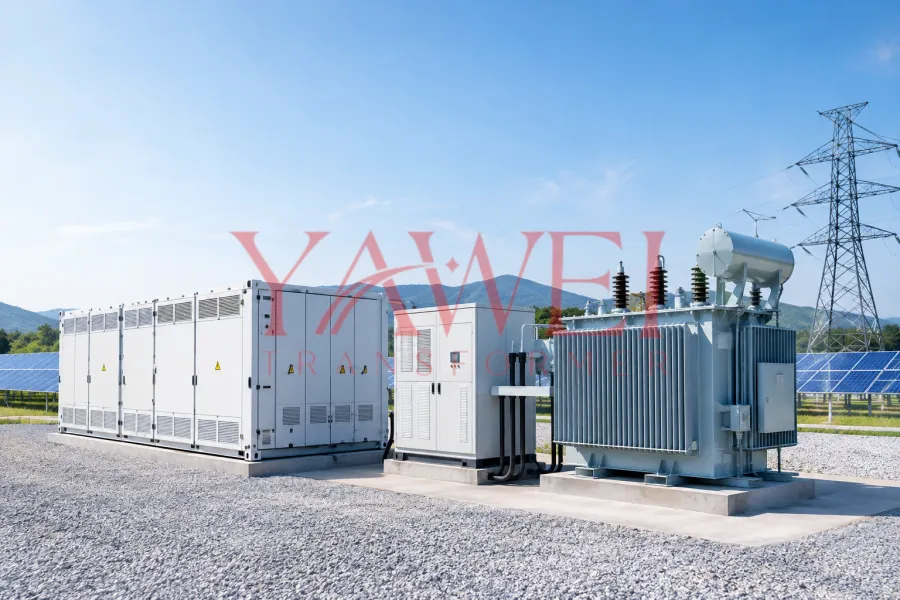
Battery energy storage systems (BESS) are becoming an essential part of modern power infrastructure. They help balance renewable energy generation, support grid stability, reduce peak demand, and provide flexible power for commercial and industrial facilities.
However, a successful battery storage project requires more than battery containers and power conversion systems. The transformer connecting the battery energy storage system to the electrical network is equally important.
Choosing the wrong transformer capacity, voltage ratio, impedance, or cooling configuration can create unnecessary losses, limit system output, and complicate grid integration.
A BESS transformer must be selected according to the power conversion system (PCS), the required grid connection, the operating profile, and the project’s electrical specifications—not simply the battery capacity in MWh.
This guide explains the key engineering and procurement considerations for selecting a transformer for a battery energy storage system.
1. What Is a BESS Transformer?
A BESS transformer is a power transformer used to connect a battery energy storage system to an electrical distribution or transmission network.
In a typical AC-coupled configuration, the power conversion system converts the battery’s DC power into AC power during discharge. The transformer then adjusts the voltage to the level required by the facility or grid.
During charging, electrical power flows in the opposite direction, from the grid through the transformer and PCS to the batteries.
Depending on the project design, a BESS transformer may perform one or more of the following functions:
Step up the PCS output voltage to a medium-voltage collection network.
Step down grid voltage to the voltage required by the PCS.
Provide electrical isolation between system components.
Establish the required grounding and neutral arrangement.
Support grid connection requirements, including voltage regulation and fault performance.
For utility-scale projects, the transformer may connect a group of PCS units to a medium-voltage collector system or connect the collector system to a higher-voltage substation.
The exact arrangement depends on the project architecture and grid connection design.
2. Understand the BESS Power Conversion Architecture
Before selecting a transformer, buyers should identify where it sits in the electrical system.
PCS step-up transformer
This transformer is installed between the PCS output and the medium-voltage collection network. It typically increases the PCS output voltage to a level such as 11 kV, 22 kV, 33 kV, or another project-specific voltage.
Main substation transformer
Larger BESS projects may use a main transformer to connect the medium-voltage collection system to a higher-voltage utility network, such as 66 kV, 110 kV, 132 kV, or 220 kV.
Integrated or skid-mounted transformer solution
Some projects combine the PCS, transformer, switchgear, and auxiliary equipment into an integrated power conversion station. In these applications, equipment dimensions, cable interfaces, cooling, protection, and transportation requirements must be coordinated between suppliers.
These configurations are not interchangeable. The transformer supplier should understand the complete electrical arrangement before finalizing the design.
3. How to Calculate the Required BESS Transformer Capacity
Transformer sizing is one of the most important steps in BESS procurement.
Battery energy capacity is expressed in megawatt-hours (MWh), while active power is expressed in megawatts (MW). Transformer capacity is normally expressed in kilovolt-amperes (kVA) or megavolt-amperes (MVA).
These values describe different characteristics of the system.
For a preliminary estimate, transformer apparent power can be calculated using:
Transformer apparent power (MVA) = Active power (MW) ÷ Power factor
For example, consider a battery energy storage project with the following requirements:
Rated active power: 10 MW
Target power factor at the relevant operating point: 0.95
The calculated apparent power is:
10 MW ÷ 0.95 = 10.53 MVA
A transformer rated at 10.53 MVA would not automatically be the correct selection. The engineering team must also consider reactive power requirements, PCS operating limits, ambient temperature, altitude, cooling performance, overload requirements, auxiliary loads, and applicable derating factors.
A higher standard transformer rating may be required.
Does battery duration determine transformer capacity?
Not directly.
A 10 MW / 20 MWh BESS and a 10 MW / 40 MWh BESS both have a nominal active power rating of 10 MW, despite having different energy capacities.
If their PCS ratings and electrical operating requirements are identical, their transformer power requirements may be similar. The additional battery capacity primarily changes the duration for which the system can charge or discharge.
However, the final selection must account for the actual operating profile and project-specific requirements.
4. Select the Correct Primary and Secondary Voltages
The transformer voltage ratio must match the PCS output voltage and the required network connection.
Common project configurations include:
| APPLICATION | ILLUSTRATIVE VOLTAGE CONFIGURATION |
|---|---|
| Small commercial BESS | Low-voltage PCS to 400 V or 480 V distribution, depending on system design |
| Industrial energy storage | Low-voltage PCS to 11 kV or 13.8 kV |
| Utility-scale BESS | PCS output to 22 kV or 33 kV collection network |
| Grid-connected storage substation | Medium-voltage collection network to 66 kV, 110 kV, 132 kV, or higher |
These are examples, not universal design rules.
For North American projects, 480 V and 13,8 kV may be relevant, while projects in other markets may use 400 V, 11 kV, 22 kV, or 33 kV. The actual voltage must be confirmed against the PCS datasheet and the utility’s connection requirements.
Buyers should provide both winding voltages, the system frequency, the grounding arrangement, and the required insulation levels.
5. Why Transformer Impedance and Vector Group Matter
Transformer impedance and vector group affect system performance, protection, and compatibility with other electrical equipment.
Transformer impedance
Impedance influences voltage regulation and the current that can flow during a fault. It must be coordinated with the PCS, switchgear, protection settings, and network short-circuit study.
A higher impedance is not automatically better, and a lower impedance is not always preferable. The correct value depends on the system design and applicable requirements.
Vector group
The vector group defines the winding connection and the phase displacement between the high-voltage and low-voltage sides.
For example, a Dyn11 configuration may be suitable for some distribution applications, but it should not be specified automatically for every BESS transformer.
The PCS manufacturer and project electrical engineer should confirm the required vector group, neutral availability, grounding method, and compatibility with the overall system.
Parallel operation
If multiple transformers operate in parallel, their voltage ratios, phase displacement, impedance characteristics, and other relevant electrical parameters must be compatible with the system design.
6. Consider Bidirectional Power Flow, Harmonics, and Thermal Performance
Unlike a conventional one-way load application, a grid-connected BESS commonly charges and discharges through the same transformer.
The transformer must be suitable for the intended operating conditions in both directions of active power flow.
However, bidirectional operation alone does not necessarily require a special transformer design. The important factors are the electrical waveform, loading profile, thermal limits, protection requirements, and applicable specifications.
Harmonic performance
PCS equipment uses power electronics, which can introduce harmonic currents and voltage distortion.
The transformer specification should therefore identify the expected harmonic environment and any applicable limits. The engineering team can then evaluate additional winding losses, stray losses, temperature rise, and any necessary design adjustments.
Do not assume that every BESS transformer requires the same harmonic derating factor. The requirement should be based on the actual converter characteristics and engineering assessment.
Cooling and ambient conditions
Oil-immersed transformers with ONAN cooling may be suitable for many outdoor applications. Other cooling arrangements may be appropriate where higher ratings or specific thermal conditions apply.
Dry-type transformers can be considered where indoor installation, fire-safety requirements, or site constraints favor that design.
The choice should consider ambient temperature, altitude, ventilation, humidity, dust, corrosion exposure, installation clearances, and maintenance access.
7. Oil-Immersed vs. Dry-Type Transformers for BESS
Both oil-immersed and dry-type transformers can be used in battery storage projects. The best choice depends on capacity, location, safety requirements, and lifecycle cost.
| CONSIDERATION | OIL-IMMERSED TRANSFORMER | DRY-TYPE TRANSFORMER |
|---|---|---|
| Typical applications | Outdoor utility and industrial installations | Indoor installations and locations with specific fire-safety requirements |
| Cooling medium | Insulating liquid and cooling system | Air and solid insulation system |
| Installation considerations | Oil containment, clearances, fire protection, and environmental requirements | Ventilation, enclosure, fire requirements, and access |
| Întreținere | Oil condition and related components may require inspection | Winding cleanliness, ventilation, insulation, and connections require inspection |
| Project suitability | Often considered for medium- and high-capacity outdoor systems | Often considered where liquid insulation is undesirable or restricted |
The decision should be based on the project’s safety assessment, applicable regulations, site conditions, and total cost of ownership rather than the purchase price alone.
8. Efficiency and Transformer Losses: Look Beyond the Initial Price
Transformer losses continue throughout the operating life of a BESS project.
Two loss categories are particularly important:
No-load loss: The loss associated with energizing the transformer, even when it carries little or no load.
Load loss: The loss that increases with current and loading, including winding losses and other load-dependent losses.
The relative importance of these losses depends on how the BESS operates.
A transformer that remains energized for long periods may place greater emphasis on no-load loss. A system that frequently charges and discharges at high power may place greater emphasis on load loss and thermal performance.
Buyers should request guaranteed loss values and clarify the applicable test and evaluation requirements.
A proper economic comparison should consider expected annual operating hours, loading profile, electricity prices, project lifetime, and any contractual penalties for exceeding guaranteed losses.
The lowest initial quotation is not necessarily the lowest-cost solution over the project’s service life.
9. Transformer Standards, Testing, and Grid Compliance
The transformer must comply with the standards and technical requirements specified by the project owner, EPC contractor, and utility.
IEC 60076 is a key series of standards for power transformers. Depending on the project, other standards and requirements may also apply.
Before placing an order, confirm:
Applicable transformer standards and project-specific technical specifications.
Rated power, voltage ratio, frequency, and vector group.
Impedance, insulation levels, and grounding arrangements.
Guaranteed no-load and load losses.
Temperature-rise and cooling requirements.
Routine tests, required type tests, and any special tests.
Factory acceptance test (FAT) procedures and documentation.
Nameplate data, drawings, manuals, and quality records.
Applicable grid-code requirements and interface responsibilities.
IEC 60076 compliance alone does not automatically establish compliance with every grid code, PCS requirement, or utility specification. These requirements must be reviewed separately.
10. BESS Transformer Procurement Checklist
To obtain an accurate quotation, buyers should prepare a clear technical RFQ.
At a minimum, provide:
Project location and application.
Required transformer quantity.
Rated power in kVA or MVA.
PCS rated output power and voltage.
Transformer primary and secondary voltages.
System frequency.
Required vector group and neutral arrangement.
Required impedance and tolerance.
Cooling method and insulation requirements.
Ambient temperature, altitude, and installation conditions.
Harmonic data or PCS manufacturer’s requirements.
Guaranteed no-load and load losses.
Applicable standards and utility specifications.
Required accessories, protection, and monitoring.
Testing, documentation, and inspection requirements.
Delivery schedule and destination.
Commercial terms, payment conditions, and warranty.
If some parameters are not yet available, the buyer can submit the PCS datasheet, single-line diagram, and preliminary project specifications so the transformer supplier can identify the outstanding engineering decisions.
11. How Yawei Transformer Supports BESS Projects
Yawei Transformer manufactures power and distribution transformers for utility, industrial, and renewable energy applications.
Our product portfolio covers customized transformer solutions for different voltage levels, capacities, installation environments, and international project requirements.
For battery energy storage projects, the transformer configuration should be developed in coordination with the PCS specifications, grid connection design, operating profile, and project technical requirements.
When requesting a quotation from Yawei Transformer, buyers are encouraged to provide the project rating, PCS voltage, grid voltage, required standards, loss targets, and delivery location.
This information helps our engineering and sales teams evaluate the appropriate transformer configuration and prepare a more relevant commercial proposal.
Explore our solar power transformer solutions for related renewable energy applications.
Întrebări frecvente
What size transformer is required for a 10 MW BESS?
The required transformer rating depends on the PCS active power, power factor, reactive power capability, loading conditions, and applicable derating factors. At a power factor of 0.95, 10 MW corresponds to approximately 10.53 MVA before additional design considerations.
Can a standard power transformer be used for a BESS?
Yes, a suitably designed standard power transformer may be used if it meets the BESS electrical, thermal, harmonic, protection, and grid-connection requirements. The design must be verified for the actual application.
Does a BESS transformer need to support reverse power flow?
Most grid-connected BESS systems charge and discharge through the same transformer, so the design must accommodate the intended bidirectional operating conditions. The transformer specification should reflect the actual duty cycle and system requirements.
Is an oil-immersed or dry-type transformer better for energy storage?
Neither is universally better. Oil-immersed transformers are often considered for outdoor utility-scale installations, while dry-type transformers may suit indoor or specific fire-safety applications. The decision depends on project conditions and requirements.
Which standards apply to BESS transformers?
IEC 60076 is a key reference for power transformer design and testing. Additional utility, grid-code, environmental, and project-specific requirements may also apply.
What information is needed for a BESS transformer quotation?
The most important inputs include the PCS rating and voltage, grid voltage, required transformer capacity, frequency, vector group, impedance, losses, installation conditions, applicable standards, and delivery location.
Request a BESS Transformer Quotation
Planning a battery energy storage project, renewable energy installation, or grid-connected storage system?
Contact Yawei Transformer with your project rating, PCS datasheet, grid voltage, technical specification, and delivery destination.
Our team can review your requirements and evaluate a customized transformer solution for your application.
Yawei Transformer — Customized Power Transformer Solutions for Utility, Industrial, and Renewable Energy Projects.