

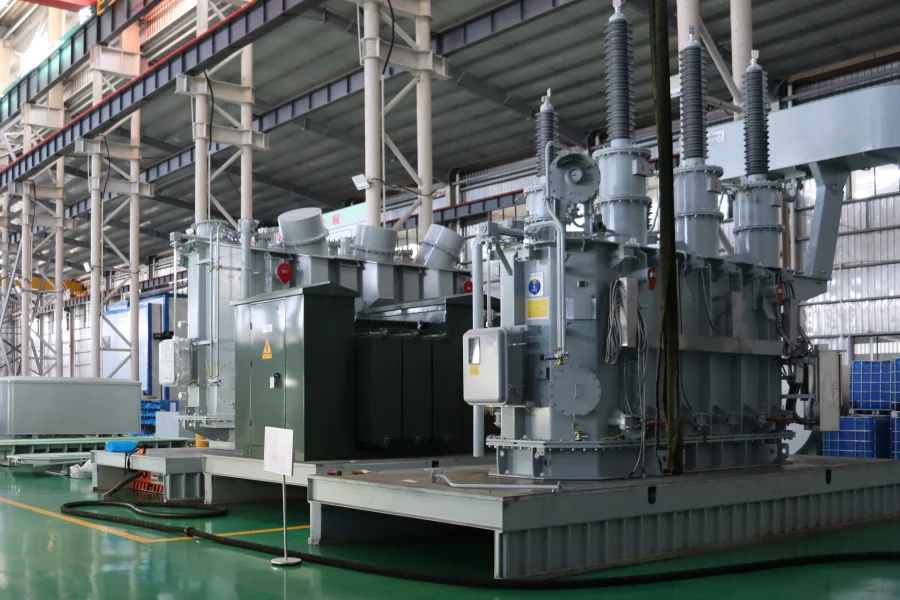
1. Introduction: The Backbone of Modern Power Systems
A power transformer is a vital electrical device used to transfer energy between circuits through electromagnetic induction. It allows electricity to be transmitted efficiently over long distances and safely delivered to end users. Transformers are indispensable in power generation, transmission, distribution, and industrial applications.
They serve as the backbone of modern electrical infrastructure, supporting:
-
Utility grids: Transmission and distribution substations
-
Industrial facilities: Heavy machinery, smelting, and production plants
-
Commercial buildings: Hospitals, offices, and data centers
-
Renewable energy: Solar, wind, and hybrid power plants
Power transformers are engineered for high reliability, long service life, and compliance with international standards like CE, UL, CSA, and GOST.
2. Basic Definition and Function
A power transformer is a static AC device that changes voltage levels without changing frequency. Its key functions include:
-
Step-up voltage: Increases voltage for long-distance transmission to reduce line losses
-
Step-down voltage: Reduces voltage to safe levels for industrial, commercial, and residential use
-
Electrical isolation: Provides safety between circuits and prevents direct electrical contact
-
Voltage regulation: Maintains consistent voltage under varying load conditions
Transformers are classified based on application, installation, voltage rating, insulation, and cooling type.
3. Working Principle
The operation of a transformer is based on Faraday’s Law of Electromagnetic Induction.
3.1 Step-by-Step Process
-
AC voltage applied to primary winding → current flows
-
Magnetic flux generated in the laminated core
-
Flux induces voltage in secondary winding
-
Power delivered depends on turns ratio:

3.2 Key Characteristics
-
Voltage ratio = turns ratio
-
Frequency remains constant
-
Power transfer is magnetic, not electrical
4. Main Components of a Transformer
| Component | Function | Notes |
|---|---|---|
| Core | Provides magnetic path | Laminated silicon steel reduces losses |
| Windings | Conduct electrical energy | Copper/aluminum; primary & secondary |
| Insulation | Prevents short circuits | Paper, resin, oil-based |
| Cooling system | Dissipates heat | ONAN, ONAF, OFAF, or air-cooled |
| Bushings | Connects electrical circuits safely | High-voltage & low-voltage types |
| Conservator & breather | Accommodates oil expansion | Removes moisture and impurities |
Additional Notes:
Oil-immersed transformers use mineral or ester-based oil for both cooling and insulation. Dry-type transformers rely on air circulation or cast-resin insulation, suitable for indoor installations.
5. Transformer Types and Their Applications
5.1 Distribution Transformers
-
Step-down voltage to usable levels (6 kV – 35 kV → 400/230 V)
-
Typical capacity: 10 kVA – 5 MVA
-
Applications: Residential areas, small commercial buildings
5.2 Power Transformers
-
Higher voltage conversion (up to 500 kV, 10–1200 MVA)
-
Used in transmission networks, substations
5.3 Pad-Mounted Transformers
-
Ground-level distribution transformers
-
Urban & residential use
-
Fully enclosed, weatherproof
5.4 Pole-Mounted Transformers
-
Mounted on utility poles
-
Typically 10 kVA – 500 kVA
-
Rural/suburban distribution
5.5 Dry-Type Transformers
-
Indoor, fire-safe
-
10 kVA – 10000 kVA
-
Office buildings, hospitals, data centers
5.6 High Voltage Transformers
-
66 kV – 500 kV
-
10 MVA – 1200 MVA
-
Used for transmission substations and heavy industry
6. Key Terminology Explained
-
Rated Voltage: Maximum operating voltage (6 kV – 500 kV)
-
Rated Capacity: Maximum power (10 kVA – 1200 MVA)
-
Impedance (%): Limits fault currents, affects voltage regulation
-
Efficiency (%): Ratio of output to input power; reduces losses
-
Load Tap Changer (LTC): Adjusts voltage under varying loads
-
Cooling Class: Determines cooling system (ONAN, ONAF, dry-type)
-
Temperature Rise: Winding/oil temperature above ambient
-
Insulation Class: Thermal endurance rating of insulation
7. Transformer Efficiency and Losses
Transformers generate two main types of losses:
-
No-load loss (core loss): Occurs even without load; depends on core material
-
Load loss (copper loss): Caused by current in windings; increases with load
Efficiency can exceed 98–99% in high-quality transformers. Low-loss designs reduce operating costs for utilities and industrial users.
8. Selecting the Right Transformer
Factors to consider:
-
Voltage and capacity requirements: Match system load
-
Installation location: Indoor (dry-type) vs outdoor (oil-immersed)
-
Environmental conditions: Temperature, humidity, altitude
-
Certifications: CE, UL, CSA, GOST
-
Maintenance requirements: Oil monitoring, cooling systems, LTC operation
Example:
-
Residential area → 50 kVA pole-mounted transformer
-
Industrial plant → 35 MVA substation transformer
9. Applications Across Industries
| Industry | Transformer Type | Example |
|---|---|---|
| Utility Transmission | HV Power Transformer | 220 kV substation |
| Industrial Plant | Power Transformer | 30 MVA furnace supply |
| Commercial Building | Dry-type Transformer | Data center UPS supply |
| Residential/Urban | Pad-Mounted Transformer | 500 kVA neighborhood supply |
| Renewable Energy | HV or Substation Transformer | Solar farm 110 kV connection |
10. Advanced Features & Trends
Modern transformers often include:
-
Smart monitoring and IoT integration
-
Online dissolved gas analysis (DGA) for oil-filled transformers
-
Partial discharge monitoring
-
Low-noise and eco-friendly designs (biodegradable oils, low-loss cores)
-
Compact modular designs for urban environments
11. About Yawei Transformer
Yawei Transformer is a global leader in transformer manufacturing and supply. Our products include:
-
Distribution Transformers: 6 kV – 35 kV, 10 kVA – 5000 kVA
-
Dry-Type Transformers: 6 kV – 35 kV, 10 kVA – 10000 kVA
-
Pad-Mounted Transformers: 10 kV – 35 kV, 15 kVA – 10000 kVA
-
Pole-Mounted Transformers: 6 kV – 35 kV, 10 kVA – 500 kVA
-
HV Power Transformers: Up to 500 kV, 10 MVA – 1200 MVA
-
Substation Transformers: 66 kV – 500 kV, 10 MVA – 500 MVA
All products are customizable, meet international standards, and serve clients in North America, South America, Europe, Africa, and Asia.
12. Conclusion
Understanding power transformers, their principles, components, and applications is essential for:
-
Engineers designing electrical systems
-
Project managers selecting equipment
-
Procurement teams sourcing reliable transformers
High-quality, certified, and well-maintained transformers ensure efficiency, reliability, and long-term system stability.
For more information and global supply inquiries: Yawei Transformer