










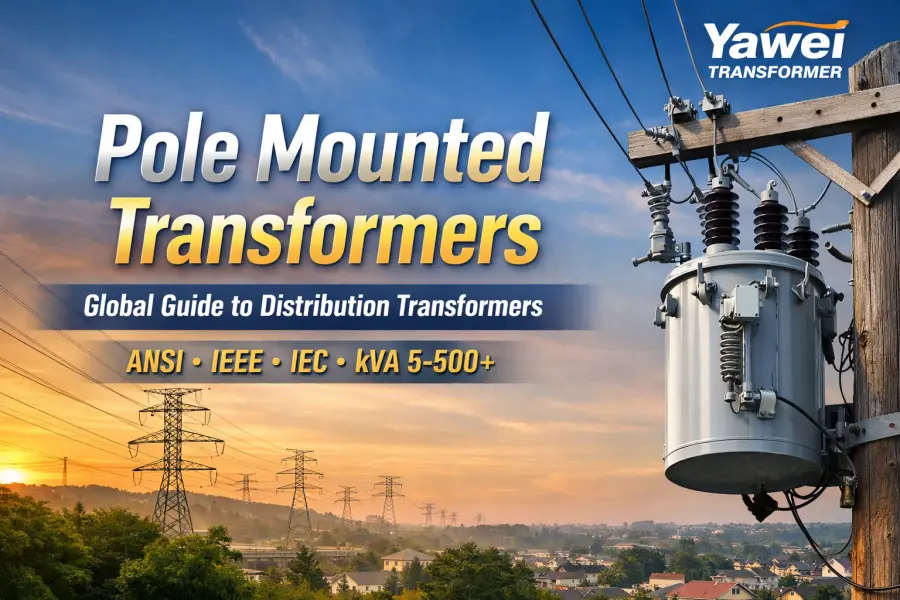
1. Introduction: The Strategic Role of Pole Mounted Transformers in Modern Power Networks
Pole mounted transformers are one of the most fundamental and widely deployed components in electrical power distribution systems worldwide. Although often overlooked by end users, these transformers form the critical link between medium-voltage distribution lines and low-voltage consumption networks.
In North America, millions of single-phase pole mounted transformers quietly supply electricity to residential neighborhoods every day. In South America, they support expanding urban infrastructure and rural electrification projects. Across Asia, Africa, and other emerging markets, pole mounted transformers remain the most economical and scalable solution for overhead distribution systems.
From a utility and engineering perspective, pole mounted transformers offer a unique balance of:
Cost efficiency
Installation flexibility
Proven reliability
Ease of maintenance
Adaptability to diverse voltage systems
As a professional transformer manufacturer, Yawei Transformer designs and supplies pole mounted transformers for ANSI, IEEE, DOE, and IEC markets, supporting customers across North America, South America, and global regions with customized technical solutions.
This guide is written to answer every major search and engineering question related to pole mounted transformers—from basic definition to advanced selection considerations.
2. What Is a Pole Mounted Transformer?
A Pole Mounted Transformer is an oil-immersed distribution transformer designed to be installed on a utility pole as part of an overhead electrical distribution system. Its primary function is to step down medium-voltage electricity (typically 4 kV–35 kV) to low-voltage levels suitable for end-user consumption.
Unlike pad-mounted transformers, which are ground-installed and often used in underground networks, pole mounted transformers are specifically engineered for overhead line applications, where space, accessibility, and cost efficiency are critical factors.
Key Functional Characteristics
Installed above ground on wooden, concrete, or steel poles
Connected directly to overhead distribution conductors
Designed for continuous outdoor operation
Typically oil-filled for insulation and cooling
Available in single-phase and three-phase configurations
3. Why Utilities Prefer Pole Mounted Transformers
From a utility company’s point of view, pole mounted transformers remain a preferred solution due to several strategic advantages:
Lower initial investment compared to pad-mounted units
Faster deployment, especially in rural or semi-urban areas
Reduced civil works, no need for concrete pads or enclosures
Simplified inspection and maintenance
High resilience in flood-prone or uneven terrain
These advantages explain why pole mounted transformers continue to dominate overhead distribution networks globally.
4. Operating Principle of Pole Mounted Transformers
Pole mounted transformers operate based on the fundamental law of electromagnetic induction, but their design is optimized for long-term outdoor reliability.
Step-by-Step Operation
Medium-voltage electricity enters the transformer through the high-voltage bushing
The HV winding generates an alternating magnetic field in the laminated steel core
The magnetic flux induces voltage in the low-voltage winding
Electrical energy is delivered at a reduced voltage suitable for end users
Key Engineering Objectives
Electrical isolation between MV and LV circuits
Stable voltage output under varying load conditions
Minimal core and copper losses
Safe operation under lightning and surge conditions
5. Structural Components of Pole Mounted Transformers
5.1 Core Design
The core is the heart of the transformer and directly affects efficiency.
Common materials include:
Cold-rolled grain-oriented silicon steel
Optional amorphous metal core for ultra-low no-load loss
Advanced core design helps:
Reduce magnetizing current
Improve energy efficiency
Meet DOE and IEC loss requirements
5.2 Windings and Conductors
Windings are manufactured using:
Copper conductors (higher efficiency, longer life)
Aluminum conductors (cost-effective alternative)
Design considerations include:
Current density optimization
Thermal performance
Short-circuit withstand capability
5.3 Insulation System
Pole mounted transformers rely on a combined insulation system:
Transformer oil (mineral oil or natural ester oil)
Cellulose-based solid insulation
This system provides:
Dielectric strength
Effective heat dissipation
Long-term operational stability
5.4 Tank and Surface Treatment
Fully welded steel tank
Designed to withstand internal pressure and thermal expansion
Anti-corrosion coating suitable for coastal and tropical environments
5.5 Standard Accessories
Typical accessories include:
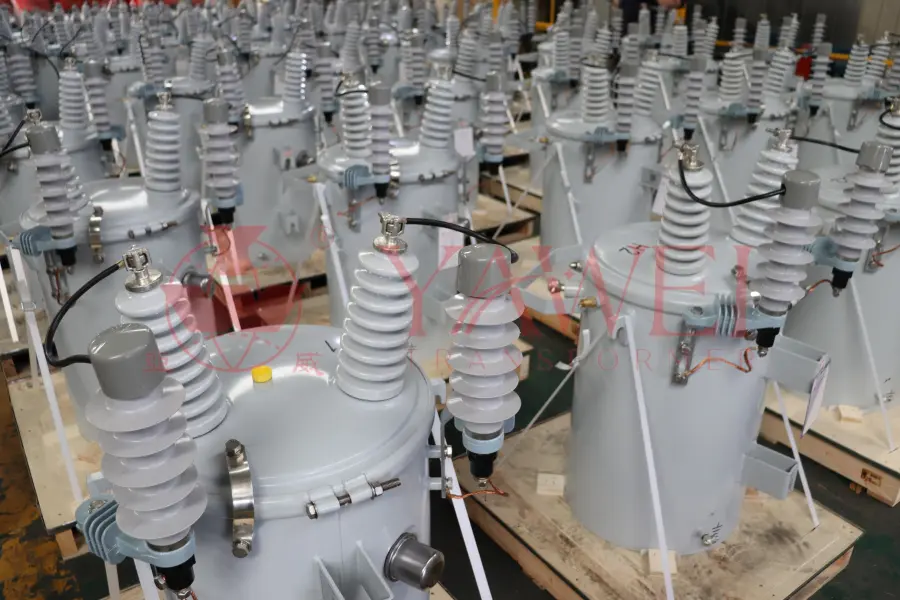
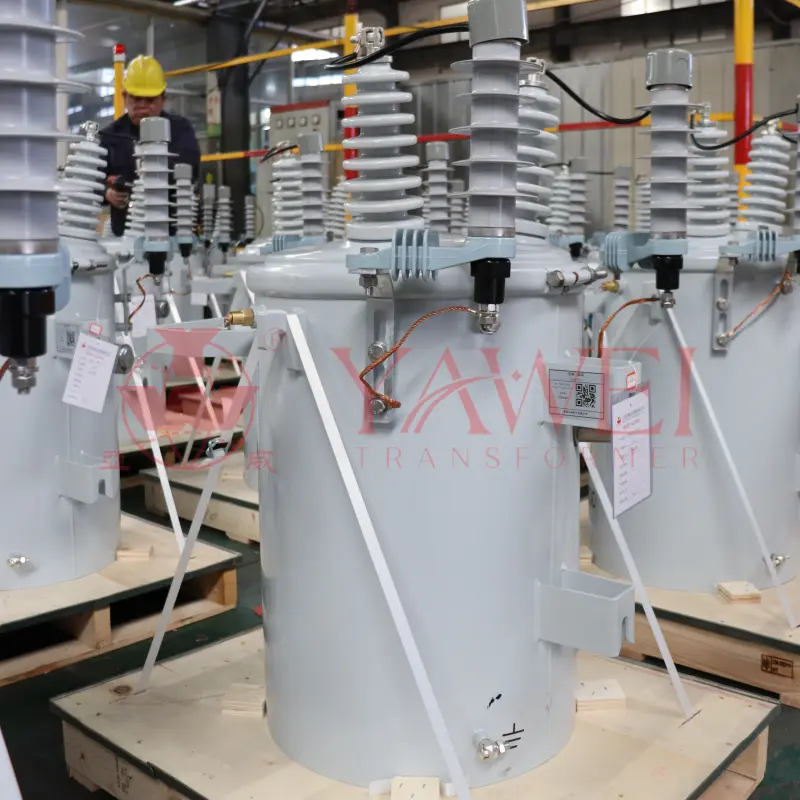
High-voltage porcelain or polymer bushings
Low-voltage bushings
Bayonet fuse or expulsion fuse
Surge arresters
Lifting hooks and pole mounting brackets
6. Types of Pole Mounted Transformers (Expanded Classification)
6.1 Single-Phase Pole Mounted Transformers
Single-phase units dominate residential distribution systems.
Typical applications:
Residential neighborhoods
Rural electrification
Small commercial loads
Capacity range:
5 kVA to 167 kVA
6.2 Three-Phase Pole Mounted Transformers
Used where higher power density is required.
Configuration options:
Integrated three-phase transformer
Three single-phase transformers connected as a bank
Applications:
Commercial buildings
Small industrial facilities
Agricultural processing plants
7. Pole Mounted Transformer Capacity Ratings (kVA Explained)
Pole mounted transformers cover a broad capacity range to match diverse load profiles.
Common Ratings
5 / 10 / 15 kVA – light residential loads
25 / 37.5 / 50 kVA – standard residential blocks
75 / 100 / 167 kVA – dense residential or mixed-use areas
250 / 300 / 500 kVA – commercial and industrial users
Capacity Selection Strategy
Utilities typically consider:
Peak demand rather than average load
Load growth over 10–20 years
Seasonal load variations
Ambient temperature and altitude
Yawei Transformer supports customers with load calculation and kVA optimization services.
8. Global Voltage Systems for Pole Mounted Transformers
8.1 North America (ANSI / IEEE)
Primary voltages commonly include:
4.16 kV
7.2 kV
12.47 kV
13.2 kV
13.8 kV
Secondary voltages:
120/240 V (residential)
240/480 V (commercial)
8.2 South America
Primary voltages:
11 kV
13.8 kV
22.9 kV
Secondary voltages:
220/127 V
380/220 V
8.3 IEC / Global Markets
Primary voltages:
11 kV
22 kV
33 kV
Secondary voltages:
400/230 V
415/240 V
9. Installation Methods and Mechanical Considerations
Single-Pole Installation
Used for small single-phase units
Lower mechanical stress
Faster installation
H-Frame or Double-Pole Installation
Required for heavier three-phase transformers
Increased structural stability
Better vibration and wind resistance
10. Typical Applications of Pole Mounted Transformers
Residential Networks
Urban and suburban communities
Rural villages
Housing developments
Commercial Distribution
Shopping centers
Office buildings
Educational institutions
Industrial & Infrastructure
Small manufacturing plants
Irrigation systems
Telecommunication towers
Street lighting
11. Advantages Compared to Other Transformer Types
Lower total installed cost
Easier inspection and servicing
Reduced land use
Proven long-term performance
Ideal for overhead distribution
12. Applicable Standards and Compliance
Pole mounted transformers manufactured by Yawei Transformer can comply with:
ANSI C57 series
IEEE C57 standards
DOE energy efficiency regulations
IEC 60076
Utility-specific technical specifications
13. Energy Efficiency and Loss Optimization
Modern pole mounted transformers must meet strict efficiency targets.
Key design strategies include:
Optimized core geometry
High-grade silicon steel
Reduced copper losses
Optional amorphous core design
14. Environmental and Safety Considerations
Fire-safe natural ester oil options
Reduced environmental impact
Improved biodegradability
Lower risk in residential areas
15. Pole Mounted vs Pad Mounted Transformers
Pole mounted transformers remain the preferred choice where:
Overhead lines are used
Cost control is critical
Rapid deployment is required
16. Future Development Trends
Higher efficiency requirements
Smart monitoring integration
Eco-friendly insulation systems
Longer service life
17. Why Choose Yawei Transformer
Specialized distribution transformer manufacturer
Experience in ANSI & IEC markets
Custom engineering support
Competitive global supply capability
Reliable quality and delivery
18. Conclusion
Pole mounted transformers are a cornerstone of global power distribution infrastructure. Their reliability, flexibility, and cost-effectiveness ensure they will remain indispensable for decades to come.
For utilities, EPC contractors, and distributors seeking high-quality pole mounted transformers, Yawei Transformer offers professional engineering solutions tailored to global standards and real-world operating conditions.