










How Does a Transformer Work? A Complete Guide to Transformer Working Principle

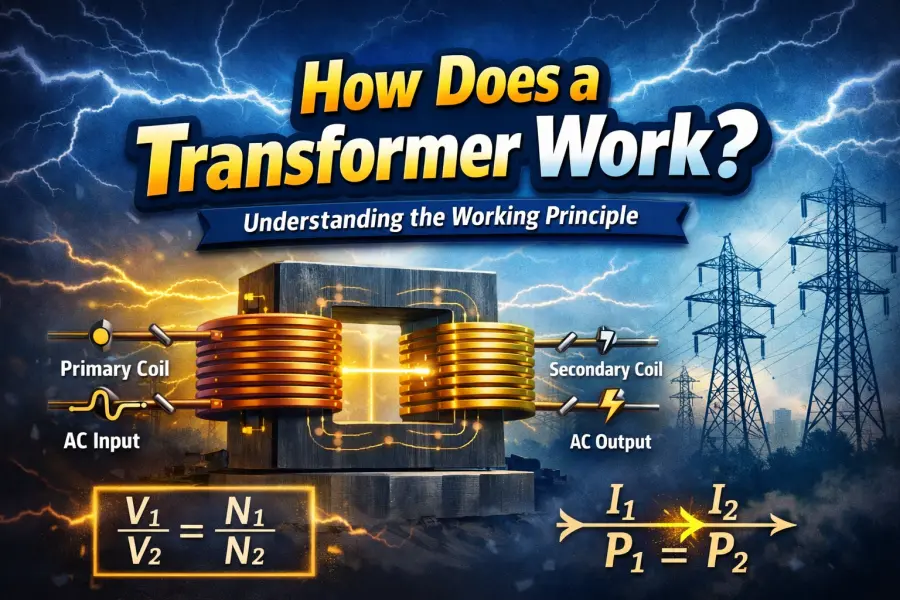
Illustration of a transformer showing primary and secondary windings, magnetic core, AC input and output, and voltage transformation mechanism, including turns ratio formula and electromagnetic induction principles, explaining how a transformer works in power systems

Introduction

Transformers are one of the most essential components in modern power systems. From large power plants to residential distribution networks, transformers make it possible to transmit electricity efficiently over long distances and deliver safe voltage levels to end users.

But how does a transformer actually work?

In this guide, we explain the transformer working principle, including electromagnetic induction, turns ratio, voltage transformation, and energy transfer — in a clear and practical way for engineers, students, and power industry buyers.


1. The Basic Idea: Changing Voltage Without Moving Parts

A transformer is a static electrical device that transfers electrical energy between circuits through electromagnetic induction.

Unlike generators or motors, transformers:

  • Have no moving mechanical parts

  • Do not generate electricity

  • Do not convert electrical energy to mechanical energy

  • Simply change voltage levels

They can:

  • Step up voltage (increase voltage)

  • Step down voltage (reduce voltage)

This ability is what makes long-distance power transmission possible.


2. The Core Principle: Electromagnetic Induction

The operation of a transformer is based on Faraday’s Law of Electromagnetic Induction.

Step-by-Step Explanation

  1. An AC voltage is applied to the primary winding.

  2. Alternating current flows through the primary coil.

  3. This creates an alternating magnetic flux in the core.

  4. The magnetic flux links to the secondary winding.

  5. A voltage is induced in the secondary winding.

The key point:

A transformer only works with alternating current (AC), not direct current (DC).

Because DC does not create a changing magnetic field.

Learn More:Certified for Global Power Projects-Yawei Transformer’s Quality System, Testing, and International Compliance


3. Main Components of a Transformer

To understand how a transformer works, you must know its core components.

3.1 Magnetic Core

The magnetic core:

  • Provides a path for magnetic flux

  • Increases magnetic coupling efficiency

  • Reduces energy loss

Most transformer cores are made of laminated silicon steel to minimize eddy current losses.


3.2 Primary Winding

  • Connected to the input power source

  • Receives electrical energy

  • Produces magnetic flux


3.3 Secondary Winding

  • Connected to the load

  • Receives induced voltage

  • Delivers power to the output circuit


4. The Turns Ratio: How Voltage Is Changed

The most important relationship in a transformer is the turns ratio.

Formula:

V₁ / V₂ = N₁ / N₂

Where:

  • V₁ = Primary voltage

  • V₂ = Secondary voltage

  • N₁ = Number of primary turns

  • N₂ = Number of secondary turns

If N₂ > N₁:

➡ Step-up transformer (voltage increases)

If N₂ < N₁:

➡ Step-down transformer (voltage decreases)

Example:

If the primary has 100 turns and the secondary has 50 turns:

  • The output voltage will be half of the input voltage.

Learn More:Substation Transformer: A Complete Guide to Principles, Types, Selection, and Procurement


5. Power and Current Relationship

Ideally (ignoring losses):

P₁ = P₂

Which means:

V₁ × I₁ = V₂ × I₂

If voltage increases, current decreases.

This is why power transmission uses high voltage and low current — to reduce transmission losses.


6. Energy Losses in a Transformer

Although transformers are highly efficient (typically 95–99%), there are some losses:

6.1 Core Loss (Iron Loss)

  • Hysteresis loss

  • Eddy current loss

6.2 Copper Loss

  • Resistance heating in windings

6.3 Leakage Flux

Modern transformer design focuses on minimizing these losses to improve efficiency.

Read More:Transformer Basics: Working Principle, Structure, and Role in Power Systems


7. Why Transformers Are Critical in Power Systems

Without transformers:

  • Long-distance transmission would be inefficient

  • Distribution voltage would be unsafe

  • Industrial equipment could not operate correctly

Transformers allow:

  • Power plants to transmit at high voltage

  • Substations to reduce voltage step-by-step

  • Homes and factories to receive usable voltage


8. Frequently Asked Questions (FAQ)

Q1: Can a transformer work with DC power?

No. Transformers require alternating current to create changing magnetic flux.

Q2: Does a transformer change frequency?

No. The frequency remains the same on both primary and secondary sides.

Q3: Why is the core laminated?

To reduce eddy current losses and improve efficiency.

Q4: What determines transformer size?

Mainly power rating (kVA or MVA), voltage level, cooling system, and insulation class.

Read More:Types of Transformers Explained: Classification by Structure, Cooling, and Application


Conclusion

The transformer working principle is based on electromagnetic induction. By using a magnetic core and two windings, transformers efficiently transfer electrical energy between circuits and change voltage levels without mechanical motion.

Understanding how a transformer works is fundamental for:

  • Electrical engineers

  • Utility buyers

  • EPC contractors

  • Industrial facility managers

As global power demand continues to grow, transformers remain one of the most important devices in modern electrical infrastructure.