










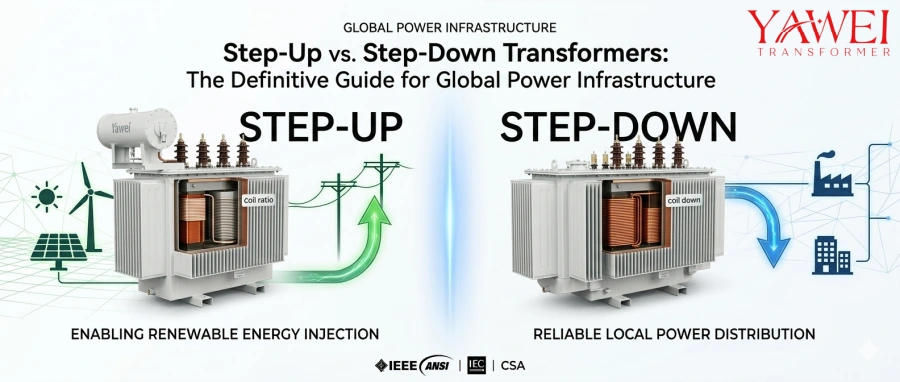
Transformadores elevadores frente a transformadores reductores: La guía definitiva para la infraestructura energética mundial
En las redes eléctricas modernas, la transformación eficiente de la tensión es la columna vertebral de un suministro fiable de energía. La rápida transición de las infraestructuras mundiales hacia una combinación de centros de demanda industrial de alta capacidad e integración de energías renovables muy descentralizada exige comprender la mecánica operativa, las configuraciones estructurales y el diseño de integración de ambos sistemas. transformadores elevadores y transformadores reductores es crucial para contratistas EPC, ingenieros de servicios públicos e integradores de sistemas por igual.
Como primer fabricante mundial de infraestructuras de distribución de energía, Transformador Yawei diseña sistemas trifásicos refrigerados por líquido que cumplen estrictamente las normas internacionales, incluidas IEEE/ANSI, IEC y CSA. Esta guía ofrece un análisis técnico exhaustivo del funcionamiento de los sistemas de aumento y reducción, dónde se instalan y cómo trabajan en armonía dentro de los marcos de ingeniería de equilibrio de planta (BOP).
1. Principios fundamentales de la transformación de la tensión
Ambos tipos de transformadores se basan en la Ley de Faraday de inducción electromagnética. La corriente alterna que circula por el devanado primario genera un flujo magnético que varía continuamente en el núcleo magnético laminado, lo que induce una tensión proporcional en el devanado secundario. El sentido de funcionamiento de esta transformación depende totalmente de la relación de vueltas (Np / Ns) entre las bobinas primaria y secundaria.
La fórmula de la pérdida de transmisión: La transmisión de energía a larga distancia incurre en importantes pérdidas de energía resistiva caracterizadas por la fórmula: Ppérdida = I2R.
Para minimizar la disipación de energía (Ppérdida) a través de las líneas de transmisión entre países, las empresas eléctricas aumentan el nivel de tensión de transmisión. Dado que la energía eléctrica se define como P = V × I, escalando la tensión a un valor alto se consigue una caída correspondiente de la corriente (I), mejorando dinámicamente la eficiencia total del sistema.
2. Transformadores elevadores: La inyección de energía a escala comercial
Un transformador elevador tiene un devanado primario con menos vueltas que su devanado secundario (Ns > Np). Por consiguiente, acepta una tensión de entrada más baja y suministra una tensión de salida más alta, maximizando la capacidad de inyección de potencia a larga distancia.
Aplicaciones críticas en infraestructuras solares y renovables
En las instalaciones solares fotovoltaicas (FV) a gran escala y en los parques eólicos, los inversores centrales y de cadena suelen generar tensiones de CA bajas, a menudo con parámetros especializados como 0,8 kV. Para inyectar eficientemente esta energía limpia en la infraestructura de red regional de media tensión (normalmente 11kV, 22kV, o 33kV), es esencial un transformador elevador robusto. Los transformadores de nivel renovable especializados de Yawei están diseñados con devanados de cobre o aluminio de alta pureza y aislamiento avanzado para manejar cómodamente los perfiles de carga variables y las graves distorsiones armónicas típicas de las salidas de los inversores solares.
Puntos fuertes del diseño para entornos difíciles
Dado que los centros de generación suelen estar situados en ubicaciones remotas y exigentes desde el punto de vista medioambiental, como zonas eólicas costeras de alta salinidad o paneles solares desérticos de alta temperatura, las unidades elevadoras de potencia de Yawei incorporan depósitos corrugados totalmente sellados (refrigeración ONAN), robustas aletas de radiador externas y líquidos dieléctricos de primera calidad para mantener una alta resistencia de aislamiento y una disipación de calor fiable durante una prolongada vida útil operativa.
3. Transformadores reductores: Distribución local de energía segura y fiable
Por el contrario, un transformador reductor tiene un devanado primario con muchas más vueltas que su devanado secundario (Np > Ns). Intercepta la energía de transmisión de alta tensión o de distribución de media tensión y la convierte en una tensión más baja, comercialmente viable y adaptada a los servicios públicos regionales y a las operaciones de instalaciones pesadas.
Fuente de alimentación industrial de gran potencia
Las plantas de fabricación industrial, los talleres de ensamblaje de automóviles, las acerías y las explotaciones mineras utilizan maquinaria de alta capacidad que exige un suministro eléctrico continuo y sin compromisos. Los transformadores trifásicos sumergidos en aceite de distribución reductora de potencia de Yawei (que normalmente reducen de redes de 10 kV-35 kV a tensiones locales estándar como 0,4 kV) están configurados con cambiadores de tomas flexibles. Esto permite a los operadores ajustar perfectamente la relación de tensiones, compensando las caídas locales de la línea y manteniendo la estabilidad estructural de la red en caso de fluctuaciones extremas de la carga.
Distribución comercial y de infraestructuras críticas
Más allá de las aplicaciones industriales, los sistemas reductores trifásicos proporcionan la infraestructura eléctrica para campus hospitalarios, centros de datos masivos, redes de transporte y centros de edificios comerciales. Estos entornos de servicios públicos exigen una alta resistencia a los cortocircuitos y un funcionamiento ultrasilencioso. Nuestra línea de transformadores refrigerados por líquido utiliza núcleos magnéticos de acero al silicio de grano orientado para reducir las pérdidas del núcleo en vacío, lo que garantiza la máxima rentabilidad en operaciones continuas.
4. Matriz de comparación técnica: Step-Up vs. Step-Down
Para ayudar a los ingenieros de proyecto durante la selección estructural, la siguiente tabla describe las diferencias estructurales y operativas entre las configuraciones de subida y bajada en los trazados de servicios públicos multifásicos.
| Parámetros técnicos | Transformador elevador | Transformador reductor |
|---|---|---|
| Relación de vueltas de bobinado | Las vueltas del secundario superan a las del primario (Ns > Np) | Las vueltas del primario superan a las del secundario (Np > Ns) |
| Transformación de la tensión | Baja tensión de entrada → Alta tensión de salida | Alta tensión de entrada → Baja tensión de salida |
| Transformación actual | Alta corriente de entrada → Baja corriente de salida | Baja corriente de entrada → Alta corriente de salida |
| Despliegue primario | Generación de energía, Plantas solares/ESS, Subestaciones | Plantas industriales, centros comerciales, redes de servicios públicos |
| Valores típicos de tensión | 0,8kV → 11kV / 33kV (escalonamiento renovable) | 10kV-35kV → 0,4kV / 230V (Distribución) |
| Capacidades comunes | 500kVA a 2500kVA+ | De 400kVA a 2000kVA+ (por ejemplo, unidades de 1250KVA) |
5. Sinergia de balance de planta en proyectos EPC de 50 MW en el extranjero
En los marcos EPC internacionales a gran escala -como una pequeña central eléctrica de 50 MW de energía solar más almacenamiento-, los transformadores elevadores y reductores no funcionan de forma aislada, sino como un ecosistema altamente coordinado. Las placas solares y los sistemas de almacenamiento en baterías se basan en unidades elevadoras que elevan la electricidad limpia generada a las tensiones de la red para su transmisión entre países.
Al mismo tiempo, los sistemas auxiliares dentro de la misma configuración de balance de planta (BOP), como las salas de control, los sistemas de refrigeración de las subestaciones locales y las pilas de carga de vehículos eléctricos integrados, dependen de transformadores reductores compactos para suministrar energía de baja tensión segura para hacer funcionar el hardware local. La asociación con un proveedor integrado como Yawei Transformer garantiza una alineación perfecta de los componentes físicos, un cumplimiento uniforme de las metodologías de prueba IEEE/IEC y un rendimiento eléctrico optimizado en toda la huella de la infraestructura.
Optimice hoy mismo su proyecto global de infraestructura energética
Tanto si está diseñando un campo solar de servicios públicos de alta eficiencia que requiere soluciones de elevación robustas, como si está estableciendo un centro de fabricación industrial que requiere una transformación precisa de reducción de media a baja tensión, el equipo de ingeniería de Yawei suministra equipos certificados fabricados a medida según las especificaciones técnicas de su proyecto.
¿Está listo para consultar a un especialista en infraestructuras? Póngase en contacto con Yawei Transformer hoy mismo para obtener asesoramiento técnico, verificaciones detalladas de los esquemas de los equipos y presupuestos competitivos para los proyectos.