










Introduction
In the evolution of modern power grids, the transition from traditional fossil fuels toward decentralized renewable energy—such as solar and wind—has brought unprecedented challenges to system stability. In these complex network topologies, the Grounding Transformer serves as the “invisible guardian.”
For EPC contractors, design engineers, and utility decision-makers, a grounding transformer is no longer just a simple inductive component; it is a critical safeguard for system protection, fault isolation, and asset security. This guide explores the physical mechanisms, selection criteria, and industry applications of these essential devices.
Part 1: Core Logic and Physical Mechanisms
1.1 Why Ungrounded Systems are “Ticking Time Bombs”
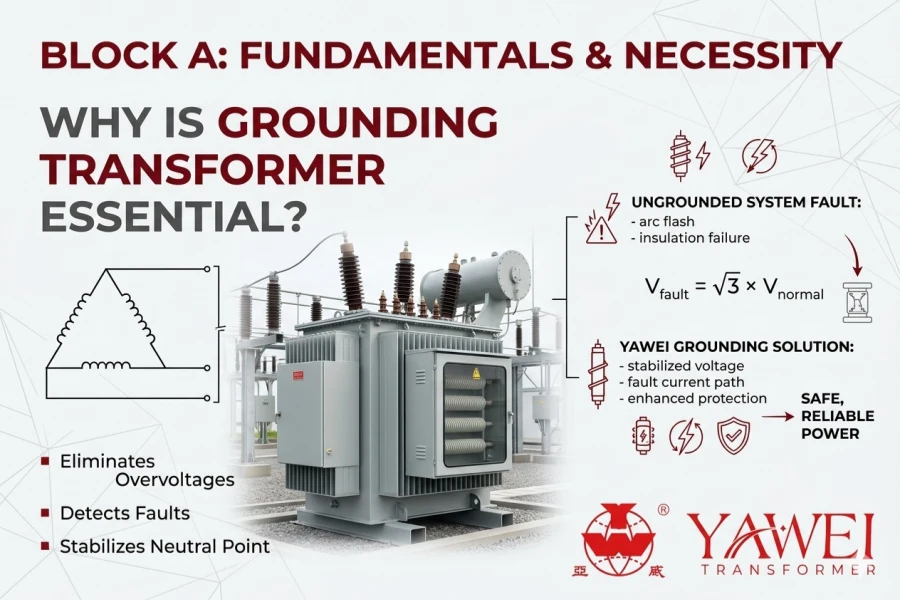
In Delta-connected or ungrounded Wye systems, the network is coupled to the earth only through distributed capacitance. When a single-phase-to-ground fault occurs, although the fault current is small (capacitive only), it triggers several lethal issues:
Arcing Overvoltages: Intermittent arcing causes system-to-ground voltage oscillations that can reach 6 to 8 times the rated voltage, directly puncturing insulation across the line.
Insulation Stress: The voltage of the non-faulted phases rises instantly to the line-to-line voltage √3 × Vphase, accelerating the thermal aging of cables and windings.
Protection Blind Spots: Because fault current is minimal, standard overcurrent protection devices fail to detect the fault, allowing the arc to persist.
A grounding transformer creates an artificial neutral point, converting “unpredictable” capacitive coupling into “controlled” resistance or inductive coupling.
1.2 The Physical Advantages of Zig-Zag Connections
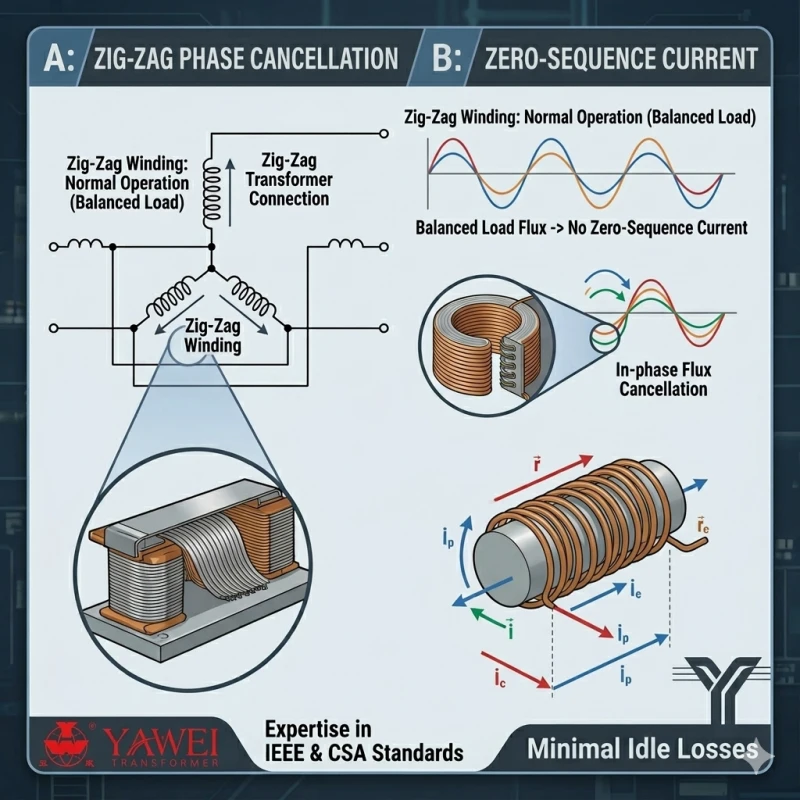
The Zig-Zag connection is the most classic design for grounding transformers, featuring two windings with opposite polarities on each core limb.
Positive/Negative Sequence Behavior: Under normal balanced operation, since the currents in the two windings are in opposite directions, the magnetic fluxes cancel each other out. The transformer exhibits extremely high excitation impedance and minimal no-load losses.
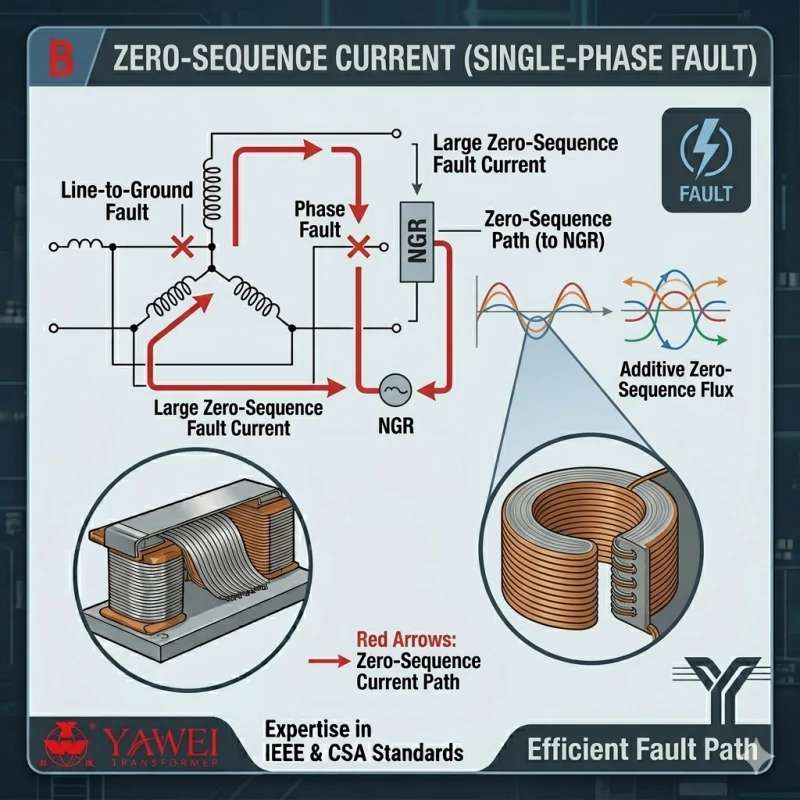
Zero Sequence Behavior: During a ground fault, zero-sequence current flows in the same phase across all windings, allowing the fluxes to add up. Due to the short leakage flux path, the transformer exhibits very low zero-sequence impedance, allowing fault current to flow smoothly.
Part 2: Engineering Parameters for Selection
When consulting with professional manufacturers like Yawei Transformer, precise parameter definition is the cornerstone of project success. Here are the six critical selection indicators for EPC projects:
2.1 Rated Current and Thermal Time
Grounding transformers do not carry continuous loads; their rated capacity is calculated based on short-time thermal effects (I²t).
Standard Durations: The IEEE C57.32 standard typically defines these as 10s, 30s, or 60s.
Engineering Advice: For remote, unmanned solar plants, we recommend a thermal rating of 60 seconds or longer to account for potential recloser failures or relay delays.
2.2 Zero Sequence Impedance
This is the most technical aspect of selection. Impedance must balance two extremes:
Lower Limit: Impedance cannot be too low, or the ground fault current will be excessive, causing high Ground Potential Rise (GPR) that threatens personnel and low-voltage equipment.
Upper Limit: Impedance cannot be too high; it must ensure enough current flows to trigger the ground overcurrent relay (51N).
2.3 Basic Impulse Level (BIL)
For outdoor substations, lightning impulse withstand voltage is paramount. Yawei products typically provide a 10%–20% margin above standard requirements to handle extreme transient overvoltages.
Learn More Grounding Transformer2.4 Cooling and Insulation Media: Mineral Oil to Vegetable Oil
Mineral Oil: Economical and efficient, suitable for most utility projects.
Natural Esters (FR3/Vegetable Oil): The 2026 industry trend. With a fire point over 300°C and high biodegradability, this is the preferred choice for ESG-compliant projects near water or forests.
Part 3: Zig-Zag vs. Wye-Delta Configurations
3.1 Zig-Zag Transformer (Single-Winding Solution)
Pros: Most compact structure, costing 20%–30% less than two-winding designs. Lower failure rate due to the absence of a secondary winding.
Cons: Cannot provide auxiliary secondary power.
Verdict: The ideal solution for space-constrained urban substations.
3.2 Wye-Delta Transformer (Two-Winding Solution)
Pros: The Delta secondary winding circulates third harmonics and can provide auxiliary power.
Typical Application: Often serves as a Station Service Transformer (SST) to power lighting, fans, and DC panels.
Note: Design requires calculating the thermal effects of combined auxiliary load and ground fault current.
Part 4: Customized Industry Solutions
4.1 Renewable Energy: Solar and Wind
In 2026, large-scale Battery Energy Storage Systems (BESS) and solar farms have rigorous grounding requirements.
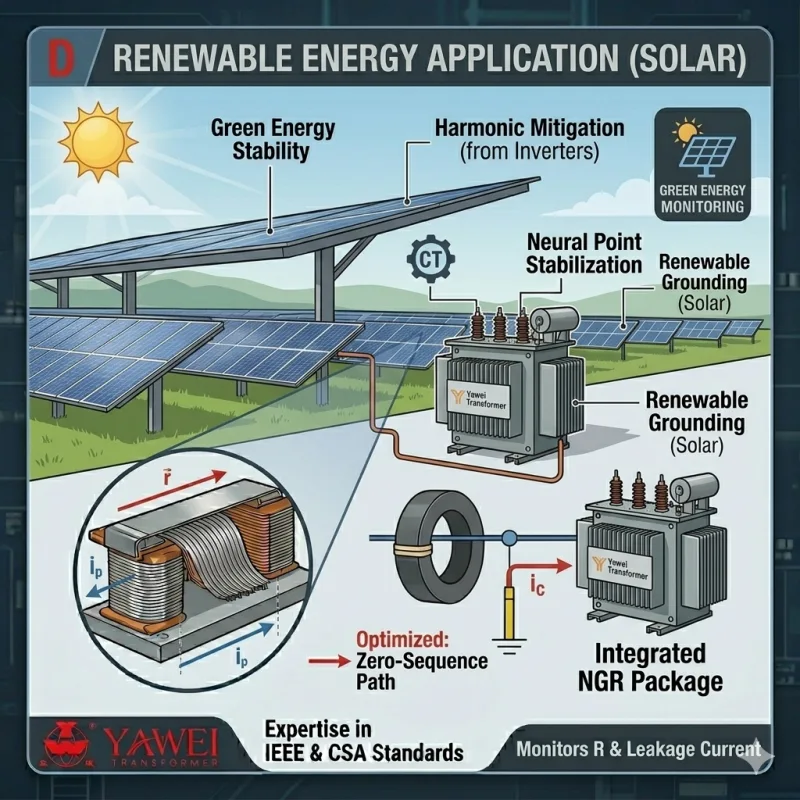
Harmonic Challenges: High-frequency harmonics from inverters increase eddy current losses. Yawei utilizes low-loss silicon steel and specialized winding transposition to ensure long-term performance without demagnetization.
Transient Overvoltages: For the rapid switching characteristics of renewable systems, the transformer must be integrated with Surge Arresters.
4.2 Data Centers: High Reliability and HRG Systems
High Resistance Grounding (HRG): Connects a high-value resistor to the neutral point, limiting fault current to 5A–10A. The system can continue operating during a single-phase fault without tripping.
Engineering Advantage: Drastically reduces arc flash hazards and protects expensive server assets from transient potential fluctuations.
4.3 Mining and Petrochemical: Explosion-proof and Corrosion-resistant
Yawei Solution: Uses hermetically sealed corrugated tanks or stainless steel tanks with C5-M (High Salinity Corrosion) rated coatings, ensuring a lifespan of over 30 years in extreme environments.
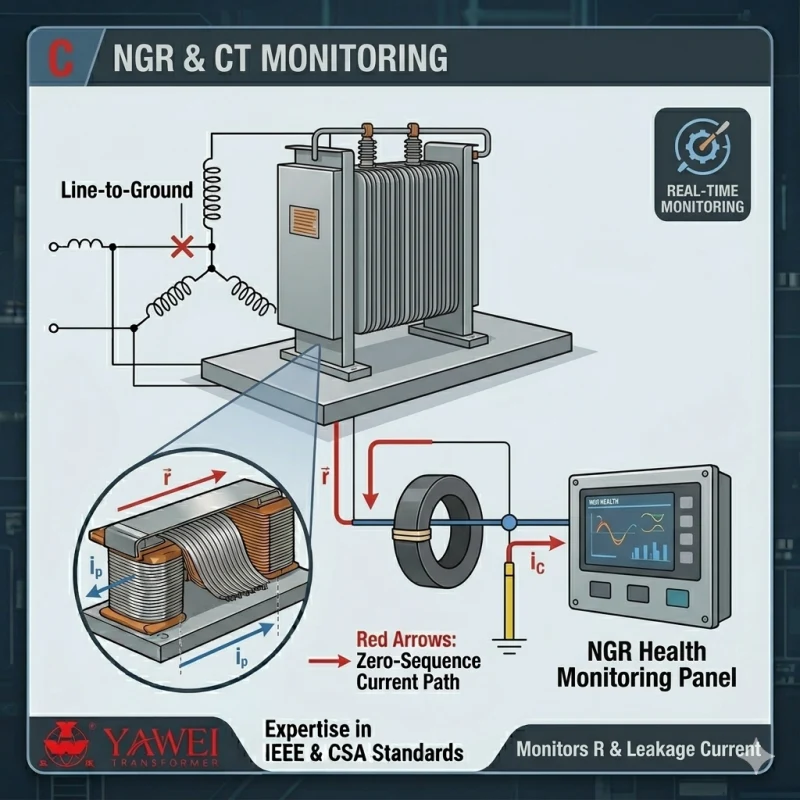
Part 5: The “Golden Partner” – Neutral Grounding Resistors (NGR)
Grounding transformers rarely work alone; they are typically paired with an NGR.
Resistance Selection: Follows R = Vln / If.(Where R is the resistance in Ohms, Vln is the line-to-neutral voltage, and If is the desired ground fault current)
Monitoring Requirements: Modern systems require NGRs with monitoring capabilities to detect resistor integrity and prevent neutral point drift.
Integrated Design: The current trend is the Grounding Package, integrating the transformer and NGR in a single enclosure to reduce field wiring.
Part 6: Common Engineering Pitfalls (Best Practices)
Oversizing Waste: Many engineers calculate based on continuous load, doubling cost and size. Only short-time thermal capacity is necessary.
Ignoring Altitude Correction: For high-altitude projects (e.g., Tibet or the Andes), air insulation degrades. Creepage distances for bushings must be increased.
Polarity Errors: Zig-Zag polarity is critical. Reversed polarity causes immediate failure upon energization. 100% factory polarity testing is mandatory.
Part 7: Standards and Global Compliance
IEEE C57.32: The entry ticket for the North American market.
CSA C22.2: Mandatory safety standard for Canada.
IEC 60076-6: Global specifications for reactors and grounding equipment.
UL Listed: Essential for U.S. data centers and industrial plants.
Part 8: 2026 and Future Outlook
Smart Monitoring: Integration of fiber optic sensors and online Dissolved Gas Analysis (DGA) to warn of internal partial discharges.
Compact Dry-type Technology: As urban cable rates increase, smaller, fire-proof dry-type Zig-Zag transformers will become the standard for indoor stations.
Modular Design: Plug-and-play standardized modules for containerized substations.
Conclusion
Grounding transformers are the bedrock of safety and resilience for modern power systems. Choosing the right solution is about more than just technical parameters; it is about optimizing the Total Cost of Ownership (TCO). Yawei Transformer remains committed to providing EPC partners worldwide with high-performance, customized grounding transformers that meet IEEE/CSA standards.