










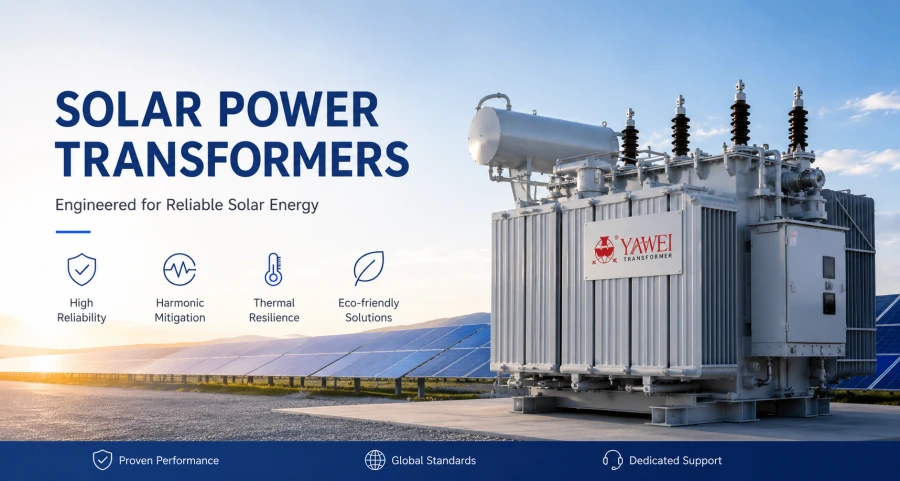
Introduction: Why Solar Transformers Have Become Mission-Critical Assets
The economics of utility-scale solar have fundamentally changed. In today’s renewable energy market, profitability is no longer determined solely by module efficiency or EPC pricing. Long-term project performance increasingly depends on infrastructure reliability — particularly within the medium- and high-voltage collection system.
Among these assets, the solar power transformer has emerged as one of the most critical and underestimated components in modern photovoltaic infrastructure.
For EPC contractors, IPPs, and utility developers managing projects above 50MW, transformer selection directly impacts:
- Grid compliance
- Plant availability
- Thermal reliability
- Harmonic stability
- Lifecycle operating cost
- PPA revenue protection
A transformer outage in a utility-scale PV plant is not simply a maintenance event. It can trigger:
- Extended downtime
- Curtailment penalties
- Grid instability warnings
- Revenue loss during peak irradiance periods
- Delays in utility acceptance testing
As renewable penetration increases globally, solar transformers are expected to operate under conditions far more aggressive than conventional power infrastructure was originally designed for.
At Yawei Transformer, we engineer solar power transformers specifically for the realities of modern renewable energy systems — including inverter-driven harmonics, rapid thermal cycling, weak-grid operation, and bidirectional energy storage integration.
1. Why Standard Distribution Transformers Often Fail in Solar Applications
One of the most common engineering mistakes in utility-scale solar projects is treating PV transformers as conventional distribution transformers.
While they may appear structurally similar, their operating environments are fundamentally different.
Traditional grid transformers typically operate under:
- Stable load profiles
- Predictable thermal conditions
- Limited harmonic distortion
- Gradual load variation
Solar transformers operate under nearly the opposite conditions.
They experience:
- Fast load ramping
- Intermittent generation
- High inverter harmonics
- Frequent thermal cycling
- Reactive power fluctuations
- Bidirectional power flow in BESS systems
These conditions create accelerated aging mechanisms that standard transformer designs are often unable to withstand over a 25-year project lifecycle.
2. Harmonic Distortion: The Hidden Thermal Threat in PV Systems
Modern solar farms rely heavily on power electronics.
Central inverters and string inverters generate non-linear loads through high-frequency switching operations. These introduce Total Harmonic Distortion (THD) into the transformer winding system.
The result is often underestimated during procurement.
Common Harmonic-Related Failure Mechanisms
Excessive harmonic content can cause:
- Localized winding hot spots
- Eddy current overheating
- Stray flux losses
- Neutral conductor overheating
- Premature insulation degradation
- Increased acoustic vibration
In several large-scale PV projects globally, transformers designed without proper harmonic consideration experienced abnormal temperature rise within the first 12–24 months of operation.
In many cases, the root cause was not material quality — but inadequate harmonic design margins.
Engineering Solutions for Harmonic Mitigation
Utility-scale solar transformers should incorporate:
- K-factor optimized winding structures
- Transposed conductors
- Magnetic shielding
- Enhanced thermal headroom
- Low-loss core design
- Harmonic-aware electromagnetic modeling
At Yawei Transformer, harmonic analysis is integrated into the transformer design phase rather than treated as an afterthought during commissioning.
This becomes especially critical in:
- Central inverter architectures
- High-density inverter blocks
- Weak-grid environments
- Solar + storage hybrid plants
3. Thermal Cycling: The Silent Killer of Solar Transformers
Unlike thermal behavior in conventional substations, solar transformers experience daily expansion and contraction cycles driven by irradiance fluctuation.
During daylight hours:
- Transformer oil temperature rises rapidly
- Windings expand under load
- Internal pressure changes occur
At night:
- The system cools significantly
- Components contract
- Moisture migration risk increases
Over decades, this repetitive mechanical stress can accelerate:
- Gasket degradation
- Oil seal leakage
- Insulation cracking
- Core loosening
- Partial discharge formation
Why Structural Rigidity Matters
For utility-scale solar applications, transformer mechanical stability is just as important as electrical performance.
Critical design considerations include:
- Reinforced tank structures
- High-compression winding clamping
- Vacuum pressure impregnation
- Precision core alignment
- Anti-vibration structural support
High-grade Grain-Oriented Silicon Steel (GOSS) also plays a major role in minimizing hysteresis losses and long-term thermal fatigue.
Learn More:Power Transformers for Data Centers: Reliable, Efficient Solutions for North America
4. Copper vs. Aluminum Windings: Lifecycle Economics vs. Initial CAPEX
One of the most debated topics in solar transformer procurement is conductor material selection.
The decision should not be driven purely by upfront cost.
Instead, EPC firms should evaluate:
- Project load factor
- Ambient temperature
- Energy pricing model
- Lifetime loss evaluation
- OPEX sensitivity
Aluminum Windings
Advantages:
- Lower initial procurement cost
- Reduced overall unit weight
- Competitive for budget-sensitive projects
Limitations:
- Higher resistance losses
- Larger conductor cross-sections required
- Greater thermal expansion
Copper Windings
Advantages:
- Higher electrical conductivity
- Lower I²R losses
- Better mechanical strength
- Improved overload capability
- Smaller winding footprint
In high-utilization utility projects, copper windings often deliver superior long-term ROI through reduced energy loss over the project lifecycle.
For large 50MW+ installations, even small efficiency gains can translate into substantial additional energy revenue over 25 years.
5. Multi-Winding Transformer Design for Utility-Scale PV Architecture
As solar plants continue scaling upward, transformer architecture becomes increasingly important for Balance of System (BoS) optimization.
Large utility projects frequently utilize:
- Dual-secondary transformers
- Split-winding designs
- Multi-inverter collection systems
These configurations help reduce:
- Civil costs
- Cable routing complexity
- Equipment footprint
- MV collection losses
However, improper multi-winding design can introduce:
- Circulating currents
- Harmonic interaction
- Uneven load sharing
- Electromagnetic interference between inverter groups
Proper galvanic isolation between low-voltage windings becomes essential.
Transformer impedance coordination must also align precisely with inverter characteristics and plant protection systems.
6. Grid Stability Requirements Are Becoming More Aggressive
As renewable penetration increases, utilities worldwide are tightening interconnection standards.
Modern solar transformers must now support advanced grid functions such as:
- Reactive power compensation
- Voltage stabilization
- Fault ride-through capability
- Frequency regulation
- Weak-grid operation
Critical Grid Compliance Considerations
Low Voltage Ride Through (LVRT)
Transformers must remain stable during temporary voltage dips without disconnecting from the grid.
High Voltage Ride Through (HVRT)
The system must tolerate temporary overvoltage events without insulation breakdown.
Flicker Mitigation
Rapid solar intermittency can create voltage fluctuation issues that impact grid quality.
Reactive Power Support
Grid operators increasingly require PV plants to contribute reactive power stabilization.
Transformer impedance and tap-changer configuration directly influence these capabilities.
Read More:2026 Top 10 Transformer Manufacturers in China
7. OLTC vs. OCTC: Which Is Better for Solar Farms?
Transformer tap changer selection is often underestimated during project design.
Off-Circuit Tap Changers (OCTC)
Suitable for:
- Stable grid environments
- Smaller utility projects
- Regions with minimal voltage fluctuation
Advantages:
- Lower maintenance requirements
- Lower CAPEX
- Simpler mechanical structure
On-Load Tap Changers (OLTC)
Recommended for:
- Weak-grid regions
- Utility-scale projects
- Areas with unstable transmission infrastructure
- Solar + storage integration
Advantages:
- Real-time voltage regulation
- Improved grid compliance
- Reduced curtailment risk
- Better voltage stability under dynamic conditions
In many emerging renewable markets, OLTC-equipped transformers are increasingly becoming a utility requirement rather than an optional upgrade.
8. The Rise of Solar + Battery Energy Storage (BESS)
The future of renewable infrastructure is no longer generation-only.
Modern utility projects increasingly integrate:
- Solar PV
- Battery Energy Storage Systems (BESS)
- Hybrid substations
- Microgrid functionality
This fundamentally changes transformer operating behavior.
Bidirectional Power Flow Challenges
Traditional transformers were designed primarily for unidirectional energy flow.
BESS integration introduces:
- Frequent charging/discharging cycles
- Rapid load reversals
- Increased thermal stress
- Extended high-load operation
This accelerates insulation aging if the transformer is not specifically designed for energy storage duty cycles.
BESS-Ready Transformer Design
Key engineering considerations include:
- Enhanced cooling systems
- Increased thermal margins
- Bidirectional protection coordination
- Dynamic load profile simulation
- Advanced temperature monitoring
As storage penetration grows globally, BESS-ready transformers are becoming essential infrastructure for future-proof renewable projects.
9. Environmental Challenges in Harsh Deployment Regions
Many of the world’s largest solar projects are located in environmentally demanding regions such as:
- Desert climates
- Coastal zones
- Tropical environments
- High-altitude regions
Each environment introduces unique reliability risks.
| Environmental Condition | Engineering Challenge | Recommended Solution |
| Desert Heat | Extreme ambient temperatures | High-efficiency cooling radiators |
| Coastal Salinity | Corrosion risk | C5-M marine-grade coating systems |
| High UV Exposure | Paint degradation | UV-resistant polyurethane coatings |
| High Altitude | Reduced cooling efficiency | Altitude derating redesign |
| Ecologically Sensitive Areas | Fire and spill concerns | Natural ester biodegradable fluids |
Environmental adaptation should never be treated as a cosmetic upgrade. It directly impacts transformer longevity and project bankability.
10. Why Smart Monitoring Is Becoming Standard
Modern solar transformers are no longer passive assets.
They are becoming intelligent nodes within digitally managed energy infrastructure.
Advanced monitoring systems now enable predictive maintenance strategies that significantly reduce unplanned downtime.
Key Smart Monitoring Technologies
Online Dissolved Gas Analysis (DGA)
Provides early warning of:
- Arcing
- Overheating
- Insulation degradation
Fiber Optic Winding Temperature Sensors
Allow direct hot-spot monitoring rather than relying solely on oil temperature estimation.
SCADA Integration
Enables:
- Remote diagnostics
- Load trend analysis
- Alarm management
- Predictive maintenance scheduling
For utility-scale projects operating under strict availability guarantees, digital monitoring is rapidly becoming a standard specification requirement.
11. Why Solar Transformers Prematurely Fail
Understanding failure mechanisms is essential for reducing lifecycle risk.
The most common causes of premature transformer failure in PV plants include:
- Harmonic overheating
- Cooling system imbalance
- Moisture ingress
- Poor sealing performance
- Insulation aging
- Inadequate thermal design margins
- Improper impedance matching
- Weak commissioning procedures
In many cases, failures originate from specification shortcuts during procurement rather than manufacturing defects themselves.
The lowest purchase price rarely represents the lowest lifecycle cost.
12. Global Standards and Project Bankability
For international EPC projects, transformer compliance is directly linked to financing approval and utility acceptance.
Bankable projects typically require compliance with internationally recognized standards such as:
- IEC 60076
- IEEE C57 series
- ANSI standards
- AS/NZS grid specifications
Grid operators and financial institutions increasingly require:
- Factory Acceptance Testing (FAT)
- Third-party inspection
- Short-circuit withstand validation
- Efficiency certification
- Environmental compliance documentation
Reliable documentation and engineering traceability are now as important as the transformer hardware itself.
Frequently Asked Questions About Solar Power Transformers
What transformer is used in a solar farm?
Most utility-scale solar farms use medium-voltage or high-voltage step-up transformers designed specifically for inverter-based renewable energy systems.
What is the difference between a PV transformer and a standard transformer?
PV transformers are engineered to handle harmonic distortion, rapid thermal cycling, fluctuating loads, and bidirectional power flow associated with renewable energy systems.
How long should a solar transformer last?
A properly designed utility-scale solar transformer should achieve an operational lifespan exceeding 25 years under normal maintenance conditions.
Are ester fluids better for solar applications?
Natural ester fluids offer advantages in fire safety, biodegradability, and high-temperature tolerance, particularly in environmentally sensitive projects.
Can one transformer support both PV and BESS systems?
Yes. However, the transformer must be specifically designed for bidirectional energy flow and dynamic load cycling associated with battery storage systems.
Conclusion: Reliability Is the True ROI Driver in Renewable Infrastructure
As global renewable energy markets mature, the role of the transformer is evolving from a passive electrical device into a strategic infrastructure asset.
For 50MW+ utility-scale solar and energy storage projects, long-term profitability depends heavily on:
- Thermal reliability
- Grid stability
- Harmonic resilience
- Predictive maintenance capability
- Environmental adaptability
The difference between a commodity transformer and an engineered renewable-energy transformer can determine decades of operational performance.
At Yawei Transformer, we design utility-scale solar transformer solutions for the realities of modern renewable infrastructure — helping EPC contractors, developers, and utilities build projects engineered for long-term stability, bankability, and grid resilience.
Suggested CTA Section
Explore More Renewable Energy Solutions
- Utility-Scale PV Step-Up Transformers
- Solar + BESS Integrated Transformer Systems
- IEC / IEEE Renewable Grid Transformers
- EPC-Oriented Substation Solutions
- Smart Monitoring & Digital Transformer Platforms
Get Technical Support
- Custom Engineering Consultation
- Transformer Loss Optimization
- Harmonic Analysis Support
- Grid Compliance Evaluation
- International EPC Project Assistance
Learn more at:Yawei Transformer